
Mass Effect received a lot of praise when it came out. It still receives a lot of it. It is considered as one of the prime examples of next-gen western RPGs. It is a status I don’t think it quite deserved. Yes, Mass Effect offers a visually and thematically rich, cinematic experience. But that thin veneer only barely covers an otherwise amazingly unpolished game. It is a game with great but unfulfilled ambitions. In that sense, it is an prime example of western RPGs, indeed.
“You won’t get away with your sloppy interface design this time. I’m gonna track you down.”
One can argue a lot about the various shortcomings of the game and whether or not they bear a significance to judge the game. But one particular area leans itself pretty well to a thorough analysis as it provides some tangible evidence to root the debate on actual facts. Almost EVERY screen in Mass Effect contains at least one major interface design flaw. When discussing this with fellow gamers, my observation was often met with disbelief. So I set out to list all of Mass Effect’s interface design flaws.
The endeavor turned out to be more laborious than I thought. The first draft was over 7500 words long. It became one of the reasons why I wasn’t able to post for such a long time. I decided to split the article into an epic trilogy of interface failure – somewhat fitting considering the game is an epic space opera. So without further ado, let us open up the first chapter. In a world of bad design choices and poor execution, there was one game that ruled them all…
Character Customization
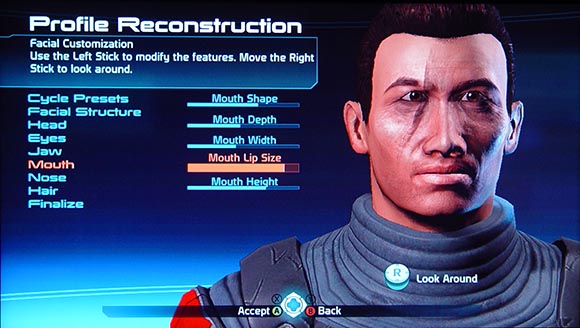
Lazy interface design. Lower their expectations off the bat. A great way to introduce players to your game.
The game greets you with a series of menus for customizing the appearance and character of the player’s avatar. The system for generating different faces is generally quite capable. It’s only shortcoming is it’s inability do render realistic hair. You are offered a huge variety of very short hair styles, even among the females. The very few long hair styles look like they are shells of solid plastic. Otherwise, the faces you generate tend to look fine. However, the system seems not to fulfill it’s true potential due to a our first interface flaw:
-
Blind re-using of generic interface elements: Facial features can be controlled by adjusting horizontal sliders. This works well for values like “Mouth Width”. A slider is good for controlling a linear value like the size of a certain feature. The problem is that the developers also chose to use the very same horizontal slider for properties like “Mouth Shape”. Instead of a linear value, this is a collection of various presets. A slider is pretty much the worst possible control for selecting an item from a collection. In oder to make a decision, you are forced to flip through ALL possible values. And you always see only one choice at a time, which hampers your ability to make comparisons between different choices. To add insult to injury, the sliders are continuous and don’t even have visible segmentation. So you have no clues about how many presets there are and which preset you are currently viewing. Finding a certain preset again after you flipped through some alternatives is often just impossible.
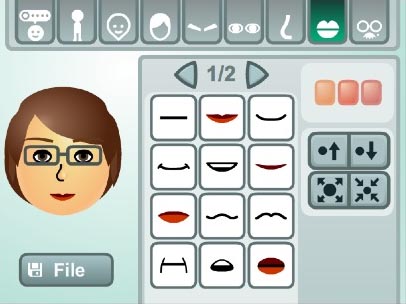
Instead of generic sliders: Mouth shape selection done right (via myavatareditor.com)
Avatar customization has become important in the recent years and we already have great examples of proper interface implementations. For example, the Mii editor on Nintendo Wii features an array of buttons for selections of different shapes of facial features. Each button has a small thumbnail preview. This gives you a quick overview of possible choices, allows quick comparisons and facilitates returning to previous settings after changes have been made.
In contrast, the solution in Mass Effect is sloppy and lazy. Instead of considering the interface requirements for each facial feature separately, a common interface element was used regardless if it’s the right one to do the job. It’s a solution to save time for a few programmers on the expense of a huge mass of users. It is also a solution which would be more likely to be used in a scenario where there resources like time are scarce. Cutting corners on an interface that players only see once per game would be a rational choice. Is this a hint to what the game’s underlying problem is? Let’s see.
HUD
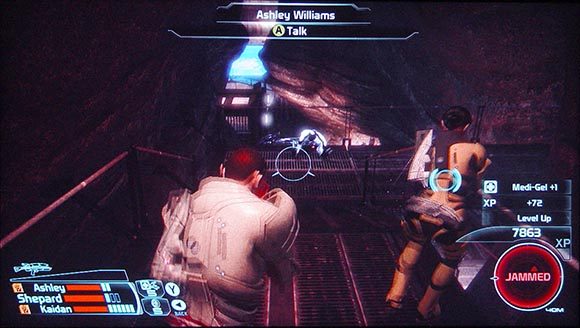
The HUD. What could have possibly gone wrong?
Let us move to something more common: The HUD. The interface overlay on the in-game view is a a very small piece of information design but one that is quite important as you stare at it most of the game. You might think that with the little amount of information it needs to communicate, BioWare should have managed to get that right. After all they do have some considerable experience in developing games. So imagine my surprise seeing so blatantly obvious information design flaws as here.
-
(Bad) Styling obscuring function: Let us focus on the health bars in the lower
rightleft corner. Off the bat, that entire area is set in italics. An unfortunate choice as it is difficult to compare the three health bars with each other when they are aligned along diagonals. Also, it makes them all rhombuses and you know what they say about rhombuses. What baffles me is WHY they set that part of the interface in italics. Italics aren’t use ANYWHERE else after all.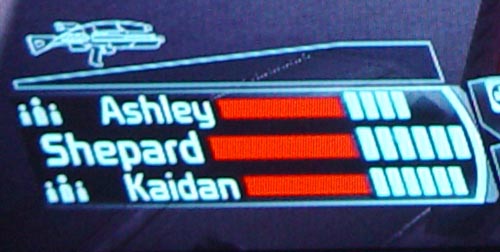
Arbitratry and misplaced italics (actually backwards-italics). Percentage bars have different lenghts. Great solutions if you want to PREVENT players from comparing health bars.
But things don’t end there. Note that the health bar of the character “Shepard” is longer than the others. The obvious explanation to that would be that Shepard has more health than the others. But he doesn’t. From playing the game longer than is good for me, I can say with confidence that the length of the bars doesn’t change as the characters level up. So I conclude that it’s just a percentage bar. Making a percentage bar longer than others you compare it to is a major information design failure. It’s difficult to comprehend because it implicitly makes players arrive at a wrong model of how the interface works. More fundamentally, it just makes comparisons between the three health bars even more difficult than it already is with the italics.
I can only speculate that the idea was to highlight Shepard as the main character. Graphic Design 101: use a larger font, put his name on top of the list rather than in-between, use spacing and text indent to make the other names visually second-order to the main character.
-
Poor choice of icons: Let’s stay in this area of the interface and focus on the two symbols right from the health bar. Here is a interesting experiment to repeat at home. Ask a person, who doesn’t know Mass Effect what the symbols mean.
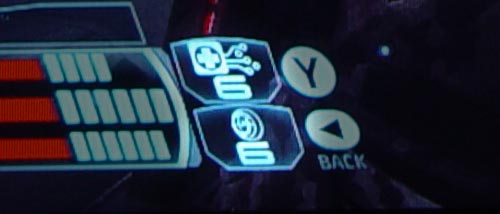
Can you guess what those mean?
They might guess that the upper icon has to do with health. But I’m pretty sure they will never guess that the lower bundle of lines is supposed to be a grenade. You see, grenades in Mass Effect are discs. Using a that disc as an icon for grenades is a typical example of the designers with a poor understanding of semiotics (using and “icon” where a “symbol” would be more fitting). A good counter-example is the use of a conventional consumer photo cameras as symbols for speed cameras in traffic signage. The actual camera may look nothing like a consumer camera but the shape of a consumer camera is more familiar and thus easier recognizable.

Using symbols instead of icons can facilitate recognition. Of course in UK, they’re doing it rong.
The first, health-related icon is just barely recognizable and only because of the use of the familiar cross. Again, one is left to wonder why the designers chose to muddle up the meaning of it by adding useless additional elements. It’s not that they contain any additional information.
It’s also worth pointing out the poor typography that comes with the poor choice of icons. The numbers representing the number of health-packs and grenades are also in italics and distorted. There is also little margin between them and the icons. They are barely legible – an unfortunate property of such a vital piece of information.
-
Poor success feedback: Another problem with the HUD is how badly it communicates success. Every time you kill an enemy or solve a quest, you get a short summary of all the experience points, money and loot you got. You also get a notification of you level up. However, that information flashes for only around 4 seconds or so. There is no way to bring it back up or read it in a log of messages. It is also set on a tiny font. Finally, important information is missing context. If I get XP I don’t know how much more I need for the next level up.

For the proper Mass Effect interface experience, try to take in all this in 4 seconds… while fighting alien cyber zombies.
Making mistakes in this part of the interface has even effects on the actual core mechanics. The driving engine behind each RPG is mostly an endless circle of performing a certain task (killing baddies) to get better at performing that very same task (killing baddies faster). This cycle is kept alive by constant feedback. Players need to SEE that they get better. Considering this I don’t quite understand how the developers could have made such mistake. I guess if you develop the game for a long time you get so used to the messages that you are able to scan them quickly enough. But then again, this should have been picked up by testers. However, there also might be a different motivation behind this. Let us keep that in mind and continue
Character Management
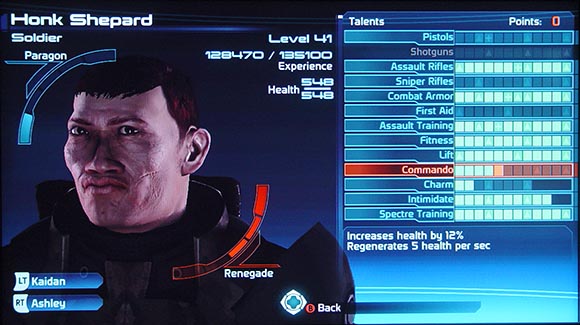
To go with the failure theme of this post, I tried to create the ugliest character the Mass Effect face generation system can support. Can you do worse?
Let us move into the more elaborate interface screens. If you manage to pick up that your character has leveled up you might find yourself in the character management menu where you can actually see and improve your stats. Or rather you should be able to do that. But this is Mass Effect after all.
-
Missing Information: The interface looks fine at first glance. You have lots of information on your characters and you can upgrade their skills by filling in cute little boxes. But then you notice that the information provided doesn’t quite add up to a complete picture. So you get information like that upgrading a certain skill “Regenerates 5 health per sec”. This seems like good info but it’s only useful if you also know what you current rate of health regeneration is and whether the improvement increases you rate by that amount or replaces it. Also, as your characters also use stats-boosting equipment, it would haven been nice to know what impact the upgrades have after all effects have been accounted for. All this information is curiously missing.
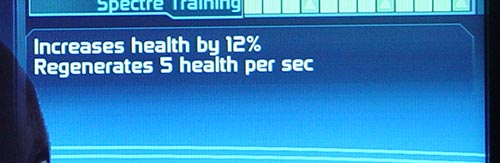
Information is useless without context.
I have a theory on why it is missing. I believe BioWare tried to make a boiled-down version of an RPG. They seem to have tried to make an RPG that could be also enjoyed by the typical Halo player. If this is true, the execution of that idea went very wrong indeed. It is as if somebody wanted to make a bicycle that people would have less troubles learning to ride – by removing a wheel.

Simple doesn’t always mean easy to learn. (via Flickr)
Hiding information from the player is not a good idea if that information is still vital. It is especially a bad idea if you still have other game elements that reference this information. In this case it backfires completely and actually accomplishes the very opposite of what the game developers were probably trying to do. It makes the game more difficult to learn and understand. Tufte may be a bit of an information design snob but in this case nothing fits better than “To clarify, add detail”.
-
Inconsistent use of visualizations vs. quantifications: Let us try to make sense of the various numbers and bars that are still present.

Three different values, three different visualization strategies. All fail.
We have health points, “Paragon” and “Renegade” bars and experience points. Note that each one of these values uses a different representation strategy. Experience Points are two numbers divided by a slash. Health points are also two numbers but written out as a fraction. “Paragon” and “Renegade” are curved percentage bars. There seems to be no reason to use so dramatically different strategies. The strategies also clash with the way those values are represented elsewhere in the game. So in the HUD, you don’t actually see the number of health points, just percentage bars. Conversely when you receive “Paragon” or “Renegade” points you get the actual numerical value in the HUD. Here in character management menu, those values appear as bars without any numbers. This effectively prohibits information transfer from one part of the game into another.
And on top of it, the actual choice of representation is very poor. The curved bars may be stylish but prohibit any comparisons and also lack explanations – what is a “Paragon” anyway? The number of experience points lacks punctuation for number formating. Proper number formating is imperative in such long numbers – especially when you use fonts that have such a great disparity in character width. I don’t want to nerd rage too much in this review but if I was really trying to confuse people by bad information design, I would have a hard time to come up with something worse.
-
Not all team members available: There is a third problem with this menu that isn’t apparent on the screenshot. You may notice that you can flip trough the various characters using the shoulder buttons. The hidden problem with that is that you can only access characters that are currently with you. You can acquire up to 6 characters over the course of the game. Only 3 of them can be part of your away team at any given time. For some reasons you can’t view the stats of the characters that are not in your team right now. You can only switch characters when you leave your ship. This means you need to actually begin a mission with a character to access it’s stats screen. This prevents you from using the information in the stat screen to make an informed decision about which members to choose for the away team. Inconsistently, the characters not in your team will still receive experience points and still level-up. You just can’t see it. It may be not that big of a deal in case of stats but just wait for the equipment screens…
End of part I
But before going there we make a short break to catch our breath. The next chapter will deal ONLY with the parts of the interface that deal with items. It is here where the most severe and most unbelievable mistakes were made. Until then, I’m eager to hear you comments on the subjects we discussed so far.
Note: This is part I of the Mass Effect: Massive Interface Fail trilogy.
Part II is here
Part III is here
The Mass Effect 2 follow-up is here


Well I haven’t played ME so I definitely see how these things can be mighty confusing. I guess my question is how does a game with such bad design choices become so popular? Are the other things it does done so well that players tend to overlook it? Is it all just hype?
I find that if I like a game well enough I’m more willing to overlook design flaws. I’m currently playing Disgaea and some of the design features there are pretty atrocious. Yet for whatever reason the game has me hooked enough that I’m willing to fight against those bad design choices even when they are a fairly inconvenient.
Interface design choices have evolved a lot over the years (like automapping – there *never* used to be auto mapping) yet even in the old days games had their fans even when the casual player could notice glaring design problems that could easily be remedied. It just didn’t seem to *matter*. Do you think developers have a similar attitude – that their game will succeed or fail on its narrative and/or gameplay elements regardless of interface design choices?
Excellent questions!
I chose to take appart Mass Effect because of the huge contrast between the quality of the interface and the game’s reputation as well as it’s cinematic visuals. You are right, older games often had atrocious interfaces. But back then we had low expectations. The genres weren’t quite as established yet so most games had little precedences they could build upon. The graphics were crude and simplistic. In this context, an flawed interface was just one thing among many on the list of shortcomings. But we accepted them mainly because we didn’t have anything we could compare them to. As the visual fidality gets better and genres become more etablished, mistakes like these pop out more prominently.
But I believe there are certain standarts that are valid regardless of the context of a product. These become more apparent as more time passes. Disparity between in-depth qualities of a work and it’s pupularity are common in all media. Bad movies still make big bucks. Good movies often go unnoticed. The true test to value a work is to see if it’s attraction holds up even if the short-term hype is over. The shallow summer block busers are quickly forgotten while the less-known sphisticated flicks will somehow always find it’s way into recomendations and favourite lists.
One of the things I enjoy regularly are the Angy Video Game Nerd videos. I think they do an excellent at pointing out some very prominent cases of game design tranwrecks from the past. They also often praise and highlight the early archievements that made it into sequels and futher products.
And yes, I believe one of the reasons for why people didn’t care so much about the interface of Mass Effect is the fact that it is a typical genre product aimed at a very specific audience that already has a lot of experience with genre conventions. With this experience, they are able to compensate for the most glaring shortcomings. If your game is aimed towards a more skeptical audience, you won’t get away so easily. Audiovisual razzle-dazzle also helped. I believe it was one of the first HD RPGs ever.
But will Mass Effect be significant for the discourse on game design in the future? My subjective impression is that other RPGs – like Fallout 3 for example – inspired a lot more insights among the critics. I believe it is exactly the lack of attention to detail like the ones I’ve mentioned that contribute to why other games will displace Mass Effect as a game worth discussing.
I’ve played many RPG’s in my life and I’ve also designed and programmed two interfaces, so I’m half-qualified to comment on this. One thing that always bothered me about interfaces in RPG’s is something you mentioned in this article, transparency in stats.
It always bothered me, but it never got my blood boiling until I started end game raiding in WoW. I mean it made me so damn angry I decided to actually make one that didn’t suck. Putting my money where my mouth is so to speak. Unfortunately, my game imploded due to the vast amount of “duct tape” style coding that went on but I learnt a thing or two about interfaces in the process.
Vague descriptions of what the talent or skill does allows programmers to change values and formulas on the fly without having to redo the interface which is very handy. But another reason why it is done is because sometimes you can’t really exlpain in less than 250 words what the skill does exactly.
For example, in the other interface I programmed, I have a flamethrower you can buy. The tool tip reads “Shoots a spray of flame away from the user in a cone shape. Short range. Very high damage.”
Note I didn’t mention how much damage it does, or how far it shoots exactly. I’ll now explain how the thing works exactly, and see if you can sum it up any better:
When the player presses the left mouse button or holds the button down, three instances are created at the tip of the barrel, two of the three instances are created every step and one every 10th step (50 steps per second) . Two of these instances are visible, one isn’t. They all leave the barrel of the gun at a velocity of 10 pixels per step, decelerating at a rate of 0.025 pixels per step until they reach 0. Two of the three instances also expand in size over time from 0 pixels across to 100 pixels across over the course of 150 steps. The other one, the invisible one, expands twice as fast. On contact with an enemy, one of the two smaller, visible instances deals 2 damage to the enemy then is destroyed. The bigger invisible one does 0.02 damage to the enemy every step, but doesn’t get destroyed as it does this. The invisible ones also stack with one another. The other smaller visible instance doesn’t do anything, it just makes the fire look fuller. The flamethrower can’t shoot through barriers. If it does come into contact with a barrier, it is instantly destroyed.
So yeah, you see what I mean. I can’t tell you how much damage it does because it all depends on the situation.
All the player needs to know is “it does lots of damage” and I think you could argue the same point for mass effect.
For example you say:
“”Regenerates 5 health per sec”. This seems like good info but it’s only useful if you also know what you current rate of health regeneration is and whether the improvement increases you rate by that amount or replaces it.”
I get your point, but provided the skill is *balanced*, all you need to know is that it improves your regen and max hp. I can’t remember what that skill did in Mass Effect but I’m assuming its stacking. If hypothetically, the previous ranks of the skill said “Regenerates 4 health per sec” and “Regenerates 3 health per sec” respectivly; you’d assume it wasn’t stacking, but the same could be said even if they included the word “increases” in front of them.
The word “stacking” would fix this problem I guess, but I’m not sure how many people are familiar with that definition of the word.
You also mention the horizonal sliders being bad; I’d argue that they aren’t ideal, I don’t think a thumbnail list would give the same level of customisation given that it is a 3d model. Something like what they have in spore would probably be the best option (not that I’ve actually used the thing, but I’ve watched other people using it). Although I also hear that they spent a huge amount of time developing the spore model editor. In fact I think I heard someone say it was the only good thing about spore.
I agree with your form over function statement about the HUD, though your arguement that a person unfamiliar with the game wouldn’t know what an exploding disc looks like is somewhat irrelevent considering you have to be playing the game in order to be faced with the challenge of using the disc. The designers would have thought using a different symbol would be out of context. It’s not a matter of comparing a real speed camera to the symbol of a regular camera, its set in space in the distant future. You wouldn’t have the symbol of a sound telegraph with a line through it when you enter the movie theater when you meant “no cellphones”.
You mentioned above that you think “Fallout 3[...] inspired a lot more insights among the critics. I believe it is exactly the lack of attention to detail like the ones I’ve mentioned that contribute to why other games will displace Mass Effect as a game worth discussing.”
I personally didn’t like Fallout 3 that much, possibly because I was such a huge fan of Black Isle that I share some of their feelings towards it. But I think the why critics talked about it so much was because the game was so broken, so many redundant skills and stats, and massive imbalance between the skills. Like science and stealth were crazy overpowered. I ended up skipping huge chunks of the game because my science was so high. Yet big guns was pretty much useless for completing the main quest line.
sorry for rambling, I’m going to bed.
As you can see I’m a big fan of rambling, so there is no reason to apologize. On the contrary, thank you for taking your time to verbalize your excellent insights! I can certainly relate to your experiences with the flamethrower.
I get your point, but provided the skill is *balanced*, all you need to know is that it improves your regen and max hp.
I agree. But then there is no reason to talk about numbers and seconds. Using such precise quantification implies a level of information fidelity the interface fails to provide otherwise.
I’m not suggesting that the good way to do game interfaces is to spell out everything in great detail. In fact, one of my favorite interfaces is in the game Ascendancy. It is a space 4X game so a very complex strategy game. Yet, all stats are communicated not by numbers but by images. So for example the industriual development of colonies is illustrated by an image of a factory. When your colony grows, the factory in the image becomes bigger and more complex. I loved that.
The only thing that is important is that the information you provide players with comes together in a complete picture and enables them to play an engaging game. In case of you flamethrower it’s ok to say it does “a lot of damage”. But when there are other similar weapons, you need to provide some means to compare them because players will want to make that decision.
I can’t remember what that skill did in Mass Effect but I’m assuming its stacking.
It is and I figured it out the way you described. However, I find it unacceptable that players are forced to collect clues from all over the place to be able to interpret the game’s cryptic messages.
…though your arguement that a person unfamiliar with the game wouldn’t know what an exploding disc looks like is somewhat irrelevent considering you have to be playing the game in order to be faced with the challenge of using the disc.
Ah, but that’s circular logic. How do you find out that the discs are grenades when you just started playing? Mass Effect has been especially criticized for being not very easy to get into. I believe things like that are the reason why.
And in the end, there is a simple solution to avoid that dilemma altogether – you could spend more time on the production design making sure that the grenades are recognizable as such without loosing their Sci-fi characteristics. So it’s still the developer’s fault.
I don’t think a thumbnail list would give the same level of customisation given that it is a 3d model
I don’t quite understand that argument. Could you elaborate a bit?
Something like what they have in spore would probably be the best option…
I haven’t played Spore for too long either but I believe Spore has exactly the same solution as the Mii editor. When you place new features such as eyes or mouths, they are represented as little thumbnails of the object itself in a big palette of buttons. Like on this screenshot.
Developing a good interface for such things can take a lot of time. But then again, nobody forces developers to offer that level customization. If you can’t pull it off right, focus on well-designed fixed characters instead. Nobody complains in games like Grand Theft Auto or just about every JRPG.
But I think the why critics talked about it so much was because the game was so broken…
Yeah, Fallout 3 has it’s own bag of problems. And I must admit that their character editor is even more broken than Mass Effect’s. On the other hand, things like the stat menu are excellent. Stats boosted by effects are highlighted and you even have as separate screen that briefly summarizes all active effects that change your attributes. That’s exactly one of the fundamentals I have been missing in Mass Effect.
I’m not sure what articles you are referring to exactly. If you have any interesting comments on Fallout 3 I’d like to read read them.
I was referring to the compilation of articles over at Critical Distance. A lot of people have some excellent articles there. Skimming over the captions they often deal with the richness of the world, shortcomings of the morality system and interactions with NPCs. It shows that the game has flaws but on a different level. This means that the fundamentals are acceptable enough to not be not too much in the focus of the attention.
P.S.: Here is an AMAZING solution to the grenade problem I forgot to mention – don’t use an icon but just spell it out. “Grenade” is not that long of a word.
Thanks for the speedy reply man
“Here is an AMAZING solution to the grenade problem I forgot to mention – don’t use an icon but just spell it out. “Grenade” is not that long of a word.”
lol I was thinking that myself.
I had a look at that Ascendency game, looks pretty cool. It sucks that I don’t have time to play it right now though, because I’m always looking for new ways of doing things. Just the other day actually, I was thinking about how being able to blow up an entire planet with a spaceship would be cool and how I couldn’t think of a game where you can really do that. Well it looks like you can in Ascendency.
The thing about Fallout 3 is that they should have employed someone who worked at Black Isle to do the story (or Charlie Kaufman). Fallout 2 is one of only a few games that managed to pull off black comedy really well (the other being Portal) and Fallout 3 totally missed that.
That is my biggest complaint about the game.
Anyway, thanks for the reply, I look forward to reading the rest of your article
[...] ruled them all…” It’s quite telling. It’s also my pick for must read of the week, and you can start at the beginning of the trilogy, if you’d [...]
wow. you are my new hero. (i’m the type of person who has all the tufte books, often more than one copy of each.) thanks for taking the time to write all this up, we luff eet.
[...] The failings of Mass Effect’s interface design. If only I could express in words my deep love … [...]
[...] minutai of a game’s menu system isn’t usually my idea of a good 7500-word essay, but this set of posts by Krystian Majewski absolutely changed my mind. It’s an examination of the many shortcomings [...]
Hey Krystian!
I think I’ve completed the game about 6 or 7 times by now and yeah you start noticing the little things after a while. Don’t get me wrong, I love Mass Effect, but it’s far from a perfect game.
The Shepard healthbar annoyed me from the start. I mean, the only explanation I could think of it being bigger than the other two is that it shows which character you’re controlling. But you can’t switch character control like in SW:KOTOR, so what would be the point of this? It would have been perfect if it had a percentage somewhere or the actual hitpoints xxx/xxx. Same thing about the shields, I would have liked to know the exact number of shield points not 1 to 6 bars.
The grenade icon is just awful. I noticed it was the grenade counter way late into the game after I was forced to use grenades (Thorian planet).
And yeah, having played WoW for 3 years of normal to hardcore raiding, a complete stats information about my character would have been great. Min/max damage with current weapon, damage reduction from armor, health regen and shield regen/sec, damage vs synthetics, damage vs humanoids, etc
Paragon/Renegade – totally agree, if you want to max them out you can barely tell how many points you’re gonna need.
[...] idea is to explore how a game can utilize symbols. I came across this idea when I was reading an article about the “failed interface” of Mass Effect (read the point about “poor choice of [...]
you raise some good points. your referencing to various graphic/information design systems and rules lend credence to your points. i just can’t get over the fact that while touting the knowledge of an authority figure on the subject you would use the word ‘italic’ to describe a font that so clearly isn’t ‘italic’. people familiar with type get frustrated when ‘italic’ is misused so, hence i know that you are not familiar with type. as a graphic designer myself i can’t justify your blatant misuse of the term. the letters are ‘oblique’, a term the laymen wouldn’t understand; if you were trying to overcome this unfamiliarity by using words present in the vocabularies of anyone who has used a word processor, you did a horrendous job of it and the word ’slant’ is obviously not included in your vocabulary.
Clearly, you have found the weak point of my entire article. My entire argument falls apart like a house of cards. I’m going to go cry myself to sleep now.
Back in the real world, the term “italic” is frequently used to describe the text leaning effect, whether or not an italic font is used to render the text. Adrian Frutiger (also a person “familiar with type”) is to blame. He started called slanted versions of his font Univers “italic” even though they were just oblique.
Good luck trolling elsewhere, Mass Effect fanboy. Hugs & kisses.
Sorry, but no. He’s got a point. If you’re going to set yourself up in an authoritative position, then you need to *not* make amateur mistakes.
Especially when your article is really just a way of using multiple hundreds of words to say “I Don’t Like The Choices They Made”.
You are confusing rhetoric with evidence.
However, if you feel that I made an argument based on implied authority or my personal opinion rather than facts, please do tell where.
Pfffft, you and the troll are being pedantic. This is a humorous blog on a website not a diplome thesis
[...] ME1 has been been cut down and streamlined, and there are plenty of general improvements (although the UI is still pretty bad). The new approach to missions and progression is so consistently predictable, [...]
[...] einerseits von einem unglaublichen Hype profitiert hat, auf der anderen Seite aber unter diversen Designschwierigkeiten litt, die vor allem das Handling des Interface zu einem gewissen unvergnüglichen Beiwerk gemacht [...]
[...] on the subject of controls and menu design is Krystian Majewski’s series of articles on the failings in Mass Effect’s design. Well worth a read. Tags: Design, Lost Planet [...]
Hi!
I have been working as a UI Designer in games for over 10 years and I enjoyed reading your ‘little’ review (all 3 of them).
There are some very valid points there, and it does make me question why certain design decisions have been made by the GUI designer on ME. I would also like to point out that some of your criticism and comments are made with very little knowledge of game development and processes, no offense intended. For example, using text instead of iconography is a very bad call in your case, you should be aware that one of the largest problems of UI development in games is localization, most AAA games get localized into many major language available inc. Japanese and Chinese. Localization creates many QA bugs, it effects production costs and time regardless of budget, time is money right? Some of these languages require text to be larger due to the readability issues. You also have to take into consideration multi-platform development, TRCs, safe-zones, milestones etc. Front-End design and HUD design in games is allot more complex than web design due to its dynamic nature.
For someone who is working on developing a Master course in game design, you take very little into consideration some of these technical limitations in game development. How many games have you developed as a UI designer? I would say that in your review you come across very naive, no offense intended.
I could point out many other issues raise as not very valid, unfortunately I have not time, sorry, deadlines, milestones and client requests are calling…
On the final I will leave you with this: Criticism comes easier than craftsmanship
PS: I would love to read more UI reviews for other games, even though we don’t have to agree I am still happy too see this part of game development is being discussed and covered. There is always something to learn.
Thank you for your lengthy comment! I hope you don’t take it personally when I disagree with you a little.
Challenges like budget or time restrictions are certainly a big deal for game development. They can explain why something is designed poorly. However, they are no excuses for poor design. After all every game has to face similar challenges and it’s the very point of game development to deliver quality products within the restrains. Luckily, many games succeed where Mass Effect failed.
As for criticism being easier than craftmanship – sure, that’s true. However, doesn’t make criticism any less valid.
You raised a good a point about the localization. I once worked on an interesting project where the entire process of localization was bascially skipped by having ALL of the interface work with visual symbols. It was quite a challenge and only successful because it required some additional UI testing. So it wasn’t quite as effective as one might think at first. In the end, symbols are also things that need to be checked for localization issues.
But that’s besides the point. This is clearly not something this team was trying. Note that there is PLENTY of text in the UI otherwise. Using the 4 symbols didn’t save any significant resources at all.
You seem to have some insights into the process so if you have any other points to consider, don’t hesitate to share it here.
[...] a year has passed since Krystian Majewski’s epic three-part dismantling of the interface in Mass Effect 1, and despite minor improvements in this regard, that’s still your best resource for [...]
I’m sorry to say, but almost the entire article is picking nits at its basest form.
You seriously considering the text slightly leaning detracts from the experience is appalling. Shepard’s name on the bottom does not have the icon explaining that he is an AI controlled party member, making it extremely easy to see which bar of health is yours at a glance. This gives plenty of space for a longer health bar; being the main character, it’s important to see how your health is, and the few pixels of length can help in that matter, and further assists players from differentiating between party members.
All it takes for a user to know what the icon below the medi-gel means, is to press Back once. It throws a grenade, and that will always be known from then on. Besides of course that this information is located in the instruction book, and the icon frequently appears when choosing grenade types.
You call it a design flaw because you can’t compare two mouth shapes? I can’t even find the right words to describe how asinine of a prospect that is. Why would you ever want to do that? Look at one, make your judgment on it. Move to another, consider it better. See another, realize it suits the face better.
I’ll admit, I only read the first part of your ‘argument’, but I foresee more insignificant points that I just can’t bring myself to force my way through the rest. Frankly, I’m wondering if you constructed this article with the sole purpose of more views brought on by being controversial, calling a popular game into question usually does so.
Yes. Interface Design and consequently Game Design is all about getting details right. There is a reason why Bungie gives entire talks about how they changed the reload time from 0.5 to 0.7 second on one of the rifles in Halo.
http://doublebuffered.com/2010/03/14/gdc-2010-design-in-detail-changing-the-time-between-shots-for-the-sniper-rifle-from-0-5-to-0-7-seconds-for-halo-3/
Like many other icons in the game, that icon explains nothing. I guess It’s supposed to mean something, but there is no way of finding out what.
This argument makes no sense. Space is not a limitation here.
The few pixels hardly improve legibility. The opposite is true, because the bars are no visually grouped, the readability is reduced. It’s fundamental Gestalt psycholgy (http://en.wikipedia.org/wiki/Gestaltpsychologie). On top of that, they are sending the wrong message – that the characters have different amounts of health.
I agree that the highlighting the main character was probably the goal here. It’s a botched up attempt at doing so.
The manual is a crutch. Especially for a modern game. It proves my point. Sure, players will learn what it is over time. But by then, there is no reason for that icon in the first place.
That’s ok. Wait until you are out of high school. Words will come easier with age. ;P
“Comparisons must be enforced within the scope of the eyespan.” – Edward Tufe, from “Envisioning Information”. Good place to start thinking about Information Design. http://www.edwardtufte.com/tufte/books_ei
You make an example of Bungie making a minute adjustment, and then immediately say a few pixels of extra space to identify your health are negligible? And then you go on to insult my intelligence based purely on your own assumptions? This makes me call your journalistic integrity into question.
One is an example of actually paying attention to details. The other one is an example of trying to fix fundamental mistakes with ineffective methods. The Halo talk is actually all about that.
You didn’t give me reasons to make any different assumptions. If you want a civil discussion, better don’t start by insulting the other party. But you are right at questioning my journalistic integrity – I’m not a journalist.
[...] Mass Effect Interface Fail – Krystian Majewski’s thorough drubbing of Mass Effect’s user interface (Part 1, Part 2, and Part 3). A must-read for anyone interested in making games. [...]
[...] There’s also a rudimentary feel to a lot of the presentation. It shows why games like Call of Duty have entire extremely competent teams of people dedicated to designing just the interface. It feels like it was tacked on to make it possible to find games, and therefore it feels clunky. Just little things, like how the weapon select menu doesn’t let you cancel out of choosing a new weapon and instead makes you deselect it, or how you can look at your squadmates collection of powers but not what they have leveled up. Or how it’s not immediately plain that your supply of heavy weapons ammo and medigel carries over between sessions, so that you shouldn’t waste it all on a lost cause. [...]
Well, testing and analysing what is wrong with a current game’s UI and fixing it is sadly the current state of game UI design. It is easy to see what is wrong with a UI after it’s in front of you, harder to plan ahead. Designers who think they have a great UI in their heads before they start usually don’t, fast and frank iteration is the key to coming to a good interface, anyone who says differently is either arrogant or naive.
Having developed a few large MMO projects myself, I identify two main problems, both organisational.
- Project managers too eager to make the UI look complete in early versions, not giving developers enough time to experiment with quick draft UIs before the time and emotional investment of doing art assets and programming has already taken place.
- Dicotomy between programmers with strong abstract reasoning and technical skils who simply don’t care about user experience and designers with poor abstract reasoning and technical skills who care deeply about user experience but cannot solve the user’s problems. Cooperation is poor, lots of inter-diciplinary arguing, blaming and huge iteration times as requirement documents are drafted and sent around.
I’m glad there’s people researching this, great article!
While I agree with the author’s examples of Mass Effect’s UI oddities, I do not think that those oddities were detrimental to the experience of the game. I personally feel that those unique UI elements and some of the head scratching that initially accompanied them were part of the hook of the series. “Generizing” everything into cookie cutter molds of “UI Standards” would create a boring gaming world indeed. Too many games already suffer from using the same or similar UI elements. When I think of modern games, one of the few UIs that stand out as characteristic AND fitting the game was Mass Effect’s. I didn’t decide to leave these comments to spite you, but I am also a graphic designer and I felt like I understood the spirit of your complaints but that perhaps you had not “seen into the future” to the place you were wishing we all could live. Distinctiveness sometimes comes at the cost of ubiquitous information access. For instance, some of the ambiguities of the Mass Effect UI just inspired me to relax a little and stop trying to micro-manage all aspects of my gameplay performance and just focus on what I was clearly being given. That said, I love in depth analyses of games, so keep up the good work on that front. I just happen to disagree with your conclusion of the ME UI being a failure. I do agree it was odd and I love it for that reason.
Here is the thing. I’m not sure if this is something that boils down to a matter of opinion. Games are a bit weird. On the one hand they are interfaces so you can apply more objective principles of usability and interface design on them. There is less wiggle room for opinion in there. An interface either works well for it’s task or not.
On the other hand, there are examples where the way you interact with an interface is the point of a game – Experience Design. Which I presume this is something you are talking about. Games like “Uplink” or “Street Rod” come to mind. I have written about this phenomenon here.
http://gamedesignreviews.com/reviews/street-rod-game-design-and-usability/
But in the case of Mass Effect it’s clear that what we have is not deliberate Experience Design. It’s the result of neglect, and perhaps lack of time.
The elements they used aren’t even unique or original. They are the same buttons, sliders, lists and text boxes you have in any other game. They just often inadequate for what you are supposed to do with them.
As a graphic designer, what you perhaps may have enjoyed about the Mass Effect is it’s visual complexity and futuristic look and feel. That’s a completely valid point. But you could have that AND make it work well too. That’s what a GOOD interface is. The interface of Metal Gear Solid: Peace Walker comes to mind as a recent example.
[...] the game, the more I realised how lacklustre it was. And then, I read Krystian Majewski’s Massive Interface Fail series, and I finally understood: The first Mass Effect‘s user interface was an unmitigated [...]
Rhombuses are equal length on all sides. The word you’re looking for is parallelogram.
You are absolutely right! I completely disregarded this fact just to make that PA joke. I was actually waiting for somebody to point this out. Thank you.
“Let us focus on the health bars in the lower right corner.”
Lower left actually
Opps, good catch!
You mispelled “failure” in the article title. To fail is a verb, not a noun.
[...] Reviews wrote up an exhaustive and compelling analysis of ME1′s XBox 360 interface design here. He makes a lot of good points about how much of the HUD breaks basic conventions of UI design, and [...]
[...] I started out by analyzing the most essential part of the combat HUD; the health display. If there is one thing that should never be obscured or confusing in an action game, it’s your health bar. Unfortunately, ME1′s display leaves a bit to be desired. Here are some of the issues pointed out by Mr. Majewki in his tear-down of the ME1 interface (which you can find here). [...]
[...] you can see, there is nothing indicating what to press to go back one step in this screenshot.See here and here for a breakdown of the 360 UI, though the guy seems to know something about design, most [...]
[...] The ‘B’ button shall be required to get players into the game (we are looking at you, Mass Effect), nor shall it be used to quit the actual game (ahem, PC versions of Crysis 2 and Arkham [...]
[...] The ‘B’ button shall be required to get players into the game (we are looking at you, Mass Effect), nor shall it be used to quit the actual game (ahem, PC versions of Crysis 2 and Arkham [...]
[...] bagatelle shall be compulsory to get players into the working plan (we are looking at you, Mass Effect), nor shall it be depleted to surrender the historical halt (ahem, PC versions of Crysis 2 and [...]