
There are very good reasons why Batman: Arkham Asylum is so critically acclaimed. It is a very good Metroid Prime clone, heavily modified to faithfully convey the characters and the world of the Batman universe. It is a good example on how to make license games.
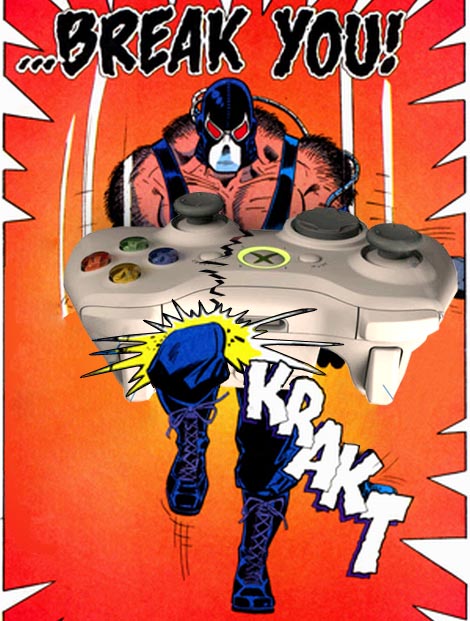
Dramatization of actual gameplay experience.
Yet, Arkham Asylum has some very clear flaws. The reason why they have been overlooked may be because they only become apparent once you put some stress on the game’s systems. This rarely happens during the single player campaign. Unfortunately, it is the very idea behind the combat challenges. I have prepared an entire series of YouTube videos this time, so let us take a look at this dark side of the Dark Knight and consider how Akham Asylum could have avoided those problems.
All features and mechanics of Arkham Asylum are tailored to perfectly represent the ideas behind Batman. The combat system is well in line with this philosophy. It is clearly focused on Batman fighting large groups of enemies – exactly like you have seen it in the comics or in the movies. You jump around from enemy to enemy, distribute brutal blows and use gadgets to wreak havoc. Consider how the game reacts when there is only one enemy remaining. Instead of having to punch one poor guy into oblivion, the game instantly toggles a sudden death mode. The very first punch you deliver instantly knocks out the last guy, no matter in what condition he is in. The combat is just not about mano-a-mano, it is about batmano-a-manos.
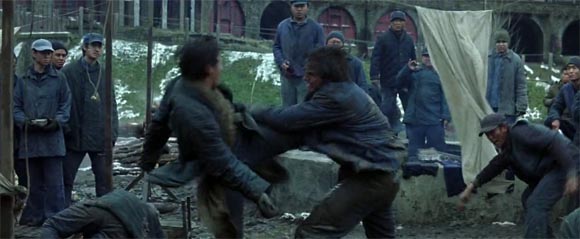
*BIFF!!* Arkham Asylum depicts the kind of group fights that have been a mainstay of the Batman series since it’s inception.
Yet, by the end of the single player mode something strange happens. The game seems to indulge a bit too much in throwing the player into combat situations. The last two bosses repeatedly combine goon combat with typical boss battles. It is as if the development team was so in love with the combat system that they were reluctant to let it go. Or perhaps they had to use it as a crutch because they couldn’t come up with interesting boss battles. The result for me was a mixture of frustration and weariness. Not the best way to finish a game, but it’s certainly better for the sake of first impression to have the weak parts in the latter portions of the game.
But then Rocksteady chose to include a challenge mode. It consists of especially difficult byte-sized challenges. They come in two variations. The Predator Challenges have Batman clear out a room in a stealthy manner while completing certain additional goals. The Combat Challenges have Batman fight 4 waves of enemies in a row while collecting points. A dramatic dichotomy opens up. The Predator Challenges are a quick, fun additions that let you explore some parts of the game in more detail for an evening or so. The Combat Challenges are among the most brutal, drawn-out, frustrating, controller-smashing experiences you can have in a modern game. Doing them alone can take longer than finishing the entire single-player campaign.
It is here where the weaknesses of the combat system reveal themselves. Unlike the varied, task-driven goals of the Predator Challenges, the Combat Challenges are stubbornly about getting a high score. The only way to do that is to chain moves together into long combos. Combos drive up a multiplier that dramatically increases the point value of the moves you make as the combo goes on. You get additional points for using different moves in one combo, not getting hit and finishing a round in one big combo. Also, Batman’s moves get more powerful as the combo goes on. EVERYTHING boils down to maintaining the combo. And due to some kinks in the combat system, this is exactly what sometimes just doesn’t work.
Trigger
Let us start with something simple. Batman can use the Batarangs and the Batrope Batclaw during combat to stun larger groups of enemies. They are a both crucial tools to thin out overwhelming clusters of goons. However, both gadgets are activated by double-tapping the shoulder triggers. I haven’t tried the game on a PS3 but for an Xbox360, the shoulder triggers are a particularly poor choice for double-tapping. Unlike regular buttons, the triggers need to travel quite a distance from the from the depressed state to being fully engaged and vice versa. That’s actually the whole point. They are built for controls where players may want to control the strength of an ongoing action – like the accelerator of a car. They are bad at quick taps and especially bad at double-taps.
So what happens is that in the heat of the action, one tends to not fully depress the trigger during the double-tap. The game registers it not as two quick presses but as a single long one. Instead of using the rope claw, Batman will do a quick crouching motion, as if he is tea-bagging someone. Instead of throwing an instant Batarang, the game goes into a FPS aiming mode. In most cases, this leads to an instant loss of the entire combo.
I’m not sure if this is something that could have been avoided by making the game recognize an only slightly depressed trigger. Perhaps this is just a case of fine-tuning. But I almost fear that the problem is a more deeper, conceptual one. Buttons, that would have been a much more reasonable choice – like the bumpers – are taken up by non-combat related functions. Double-tapping is required because holding is reserved for yet some more non-combat functions. It’s the action adventure part of Arkham Asylum holding it back from being able to work as a hardcore brawler. A notion that will return to us when we discuss other issues.
Automatic Failure
Losing a combo because of a mechanical problem is frustrating but nowhere near as frustrating as loosing it due to a clear failure of the game’s system. The combat system in Arkham Asylum uses an assist that lets batman travel automatically from one enemy to another to deal the next blow. There are clearly reproducible cases where this system just fails. Batman will move to the next enemy, but upon arrival the situation would have changed in such a way, that Batman is no longer able to execute the move. You lose the counter instantly not because you made a bad choice, but because the game made a bad choice for you.
Perhaps the most iconic example is when you attempt a ground takedown right after throwing an enemy off the ledge. The ground takedown move will often target the still airborne henchman. Batman will jump after the enemy, follow him up to the ledge of the level, drop to the ground and automatically lose the combo as he is watching his target fall into the abyss.
There are multiple variations of this theme. Punching after a Batrope Batclaw/Batarang combination will make Batman attempt to punch an enemy that will have tumbled to the ground by the time Batman reaches him. Sometimes even simple ragdoll spasms seem to prevent an already initiated ground takedown. Some of those seem to be partially attributable to a overly active camera – something we will address separately.
In general, the game seems to be bad at predicting it’s own behavior. A cardinal sin for a fighting game where success depends on thinking a step ahead.
Counter
Thinking a step ahead is actually a good segway into talking about the many failings of the counter move. Among the many moves Batman can execute, the counter move is the only defensive one. Pressing it during an incoming attack lets Batman prevent the attack and brutally punish the attacker. It’s a nice example of how the combat system represents the idea of Batman. The Dark Knight is on the offensive even when he is defending.
But the thing with the counter is that it only works when there is an attack incoming. Pressing counter with no attack around to defend against leads to an instant loss of the combo. So it becomes incredibly important to recognize opportunities for countering. Recognizing incoming attacks with your bare eyes borders on the impossible, which is probably why that’s exactly what the game expects you to do when you play the story mode on hard difficulty. On lower difficulty and in the challenge mode, the game enables not one but two indicators that are supposed to help you recognize incoming attacks. None of them work properly.
The first indicator is glowing lighting bolts that appear around the heads of attacking enemies. They are fairly inconspicuous in a crowded scene and don’t work if the enemy is off-screen. Which is probably why there is an additional warning message on the bottom of the screen encouraging you to press the counter button. Both indicators have the same problem of suggesting to counter even when counter is not possible. So they will flash if your current animation is actually longer than the enemy’s and there is actually no way for you to do anything about the attack. The indications will also continue flashing, if you are dodging and you will be well outside of the range of the incoming attack when your animation finishes. The indicators will even continue flashing even when the incoming attack is past the point where it would be blockable. So the indicators will encourage you to press the counter button even in cases where countering will cause instant failure. I had cases where the indicators didn’t stop flashing even after I failed my combo because I was actually listening to them. A cruel mockery of a broken design.
And even without the indicators, the counter is faulty. You see, there is rarely a NEED to actually use the counter. In most situations, you can simply evade an attack by dodging or punching the enemy. And the alternatives are actually much more user-friendly than the counter because they don’t cause you to lose your combo if there is no attack incoming. Combined, the game’s system actually implies to avoid the counter altogether or at least to be wary about using it. That’s unfortunate because the counter is at the core of what the combat system is trying to represent. It’s supposed to allow Batman to prevail even when he is completely surrounded by enemies. Instead, the player will avoid the midst of the battle and prefer to skim around the outskirts.
Even then, there still will be certain situations where dodging or punching is too slow and counter is the only way out. With counter not being something you can rely on, such situations become inevitable dead-ends. Of which the game has actually plenty of anyway.
Inevitable Failure
Sometimes in Arkham Asylum, failure seems to be inevitable. So quite often you get hit by things that seem to come out of nowhere. Enemies will suddenly pop in from off-screen to ruin your combo. It feels very much like that scene in Final Destination where a girl gets hit by a bus coming from off-screen in the midst of a conversation. Other times, Batman will dodge sideways and the camera will pan over to reveal that he is actually dodging right into the swinging baseball bat of an enemy. I guess that’s like the bus scene only you are the bus?
Of course, this mainly a camera issue but that’s not the only problem here. It’s also a variation of the auto-targeting making bad choices. Why would the game allow you to jump into an attack? And in fact, there are also plenty of situations where you evade an attack, dodge around and actually manage to jump back into a baseball bat you were supposed to have already avoided. If the auto-targeting isn’t able to pick up those cases, shouldn’t the collision system at least grant you immunity?
As in Final Destination, it sometimes seems like there are some failures you just can’t avoid. Either because the game’s system won’t allow you to or simply because you didn’t see them coming.
Targeting
The inherent relationship between camera and your ability to act also plays a vital role in the difficulty of actually targeting of enemies. While there is a lot of auto-targeting going on, the player can point to a specific direction in which Batman is supposed to attack. This is a vital function to pick up individual enemies but one that is sometimes made infuriatingly difficult by an overly active camera. So there are often cases where during an certain move, the camera will suddenly swivel around. A certain enemy might end up being at the opposite side of the screen than the one you are pointing to.
This doesn’t have to be tragic when fighting generic henchmen. But the game sometimes throws in some special enemies. They need to be attacked with a specific move. Attacking them normally, results in an instant failure. Together with the finicky targeting, it is a truly rage-inducing mixture. On multiple occasions, I have spent infuriating seconds of trying to jump over that one enemy armed with an electric club. The camera would spin wildly and somehow, Batman would always end up hopping over the wrong enemy.
But most of the time, the targeting failures are not that spectacular. Most of the time you will just punch in the air and fail the combo right away. There doesn’t even have to be a camera involved. Simply choosing between two henchmen standing right next to each other often turns out to be more a matter of pure chance than choice.
Camera
So let us finish this list with a simple, yet extremely common way of how Arkham Asylum let’s you fail combat challenges. I recorded around 5 hours of gameplay footage and this seemed to be the most common problem. The situation is always the same. Batman will jump away from a group of enemies towards the camera. Instead of backing up together with Batman, the camera will swivel around and show Batman standing in front on a railing while the enemies are presumably approaching him from off-screen. The only way out of this situation is to blindly attack with a gadget. Of course, this assumes that double-tapping the trigger works out this time and that you manage to target correctly in spite of the sudden flip of directions.
When talking about the reasons for such camera behavior, we can span a nice arc to what we have been talking about in the beginning. It’s Arkham Asylum’s action adventure origins shining through. Even in combat, the camera is still more likely to follow Batman around and to point in the direction he is traveling in, rather than be concerned about keeping the important information in the frame.
In action adventures, this is ok. After all, there is still manual camera control for looking around and the geometry of the levels is hard to account for. But for a competitive fighting game, this is a fatally wrong solution. Your right hand can’t manually control the camera because it’s busy mashing the buttons (Monster Hunter can get away with this). And the levels are all simple arenas anyway.
Cracking Under Pressure
So as you can see, the combat system has a lot of issues. Are they proof that Arkham Asylum is a bad game in spite of all the glowing reviews? Of course not! In fact, as already mentioned, I think the combat system is actually really good. It’s a believable and accurate representation of what combat would feel like for Batman. Actually, it has some surprising depth for an action adventure. It features and great deal of different moves and there is a lot of headroom if you really want to get good in it. But most importantly, it feels satisfying and looks cool.
I believe Rocksteady’s mistake is a very different one. It is the fact that they themselves were expecting too much from the combat system. The combat challenges and to lesser extent the latter portions of the campaign expect players to treat the game like a hard-core fighting game. The combat system has depth to accommodate that strategy to some extent, but it is ultimately just not made for it and it comes apart at the seams when pushed too hard.
I wouldn’t be writing so much about it if not for the irony that Rocksteady themselves have employed a solution for the problem in the very same game! You need to look no further than the Predator Challenges to see how to do explore the surplus depth of a game system in a safe, reasonable and enjoyable way. All Predator Challenges measure the time it takes for players to complete them. But there is actually NEVER a given time you need to beat. Instead, you earn the “medals” for Predator Challenges by performing some special tasks – such as eliminating an enemy in a very specific way. The time is kept only for the purpose of Leaderboards. The competitive aspect and the completionist aspect are kept almost orthogonal.
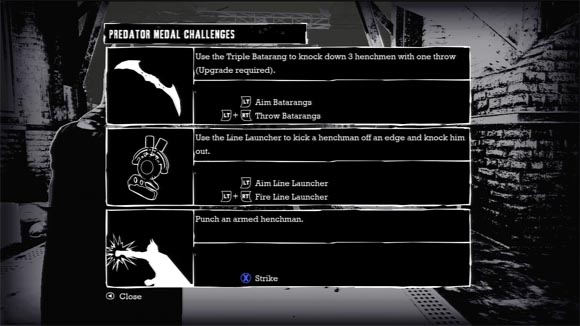
Challenges done right. Predator Challenges reward actual exploration instead of blind competition.
Why not simply treating Combat Challenges the same way? The points could have been used for Leaderboards while the medal-worthy special tasks would be to use certain moves to get rid of the enemies. In fact, this approach would have been much better at exploring the combat system. Some unique combat opportunities are actually not encouraged if you look at the bottom line only. For example, spectacular moves like throwing enemies off cliffs or bashing them against force fields yield less points than generic, repetitive ground pounds.
But in the end, simply expecting a lower score would have done the trick too. And that’s perhaps a general takeaway from the game. Even if you invested a lot of work in a game mechanic, don’t fall in love with it. Don’t expect players to use it for things it wasn’t designed to do. Under the tremendous pressure, unseeming blemishes may become breaking points.



Great write up as always, and the videos are just the icing on the cake
So now you’ll play Arkham City? I no longer have the game with me, but IIRC, the PS3 version uses L1 tap for Batarang. Batclaw (as the game doesn’t refer to it was the Batrope) is a button combination: L1 + Triangle (or L2+Triangle, I’m not sure). So those two problems seem largely mitigated, at least on PS3. Also I seem to remember that normal strikes now take noticeably longer to connect, making the counter move a much better choice for many situations. Not to mention the new ability to counter multiple enemies simultaneously.
However they also extended the entire system so the pad is more cramped by default, several moves are buttons sequences with seemingly inconsistent timings, so there’s new cracks that lead to frustration in the campaign already.
The campaign has some of those objective- / move-based combat challenges. But they tend to be awkward to do, not integrate well into normal combat situations and remain one-offs that the player just checks off the todo-list.
Interesting! It seems like they really got rid of the double-triggers. I also noticed on videos that the camera seems to show a lot more of the surrounding. I need to take a look on how those combat objectives work.
But I think I will take a break before I jump into Arkham City. Thanks for pointing out the “Batclaw” thing, btw. Corrected it!
[...] Arkham City received a lot of criticism not because it was bad but because it followed up Arkham Asylum, and Arkham Asylum felt so fresh when it came out a couple years ago. Arkham City gives Batman a chance to spread his wings (literally) and you get to interact with a lot more of Batman’s famous villains. The combat with groups of enemies still relies entirely on combos and losing the combo string is annoying and frustrating at times. Read my buddy Krystian’s write up about Arkham Asylum’s combat (which is the same in Ark… [...]
A very well detailed and fair representation of Arkham Asylum’s various flaws. At least now I know why I feel that sometimes those losses in the challenges were not entirely my fault
This is the worst review of arkham asylum I’ve ever seen, because you somehow managed to recognize the game has faults, unlike the reviewers before you, and you missed all the important ones.
http://insomnia.ac/reviews/xbox360/batmanarkhamasylum/
Here’s the only good review of Arkham Asylum on the planet. May god have mercy on your soul.
Yeah, thanks. I’ll keep in mind to lace my articles with foul language in order to appear edgy. If that’s what you are looking for, I can see how you would be disappointed.
Ah yes the “oh it has some swear words so I won’t address any of the points” defense, truly only for the highest of men.
It doesn’t have just some swear words, it is full of it. This does imply a less competent writer, indeed. But I admit I’m not a Journalist myself. You may ask around at respected editors, writers and scholars of literature for a second opinion. Don’t hold your breath though.
That being said, I’m sorry my article is not like the one you like so much. This is however inevitable as we are different people and we clearly tried to achieve different things.
It implies that the author likes to swear, nothing else. I find it amazing that you just cover your ears and ignore the swears along with everything else even if it has valid criticism (for example the combat being absolutely atrocious).
It also implies that the author has no other way of expressing criticism than by direct insult. It also implies that the author doesn’t write to actually make an argument but rather to feel good about themselves and to make others feel bad. That’s pretty much what “unprofessional” means.
Indeed, I just realized that I already read stuff by Insomnia and found it even more lacking, to say the least.
But since you insist: They don’t really say anything about combat besides that it’s “press A not to die” and that counters are telegraphed. I don’t see how that’s bad game design per se. It’s also not exactly true since there are far more combat moves involved, which you need to master if you are going for a high score. I assume they haven’t even attempted the combat challenges. Indeed all of them point out how they beaten the game on Hard but none of them even mentions the combat challenges.
My criticism on the other hand actually focuses on the combat challenges because they expose deeper flaws of the combat system – for example that the counter telegraphs are in fact misleading. I’m not attempting to do a full review of the game. This is not the point of this website. If this is why you are here, I’m sorry. That’s not what I do. Some people found my Mass Effect Interface Design articles more aggressive. If you like people insulting other people, they may be more your cup of tea:
http://gamedesignreviews.com/reviews/mass-effect-interface-fail/
Of course, someone most complete every game 100% to have a say in it, they can’t just state the obvious (which somehow you missed) like the combat being a QTE, the bosses being terrible etc. All attacks in these kinds of games are telegraphed, the difference is that in the good games (say Bayonetta or Ninja Gaiden or God Hand) the enemy does a specific animation that should warn you about the attack it’s gonna do. In Batman you just have a giant warning sign above an enemy, basically it’s just a QTE which is exactly how the whole combat system feels like. Now it’s nice that you examined the combat system in detail and pointed out some subtle flaws but that doesn’t change the fact that the combat is incredibly shallow from the start. You don’t need to do the combat challenges to figure that out, playing the game once should suffice.
As for the swearing, again it doesn’t really say anything about the authors except they don’t mind swearing but it does say something about you because you seem to be a 12 year old fundamentalist christian girl when it comes to this stuff.
I’m pretty sure they added the explicit telegraph because unlike in Bayonetta, Nina Gaiden or in God Hand, you are engaging with a lot more enemies at the same time in Arkham Asylum. As I pointed out, it’s a band-aid to cover up underlying problems with their camera and general combat dynamics.
It should be also noted that all the games you mentioend are from Japan. Japanese developers tend to have an extremely video-game savvy audience in mind. I pretty sure Rocksteady was going for something more mainstream which makes sense for a licensed title.
As for you calling me names – good luck with that attitude.
The primary issue with the combat system is that it consists primarily of pressing punch until an enemy winds up an attack, then you get a flashing indicator that you should press the counter button.
Bonus, you can press punch with the right timing to get double the combo count.
If this sounds like an entertaining game to you, then I recommend picking up DDR, you’ll have more fun, it has 4 buttons instead of 2.
Meanwhile, in games with good combat, like God Hand, there are things like startup and recovery frames, ranges on attacks, specific attacks mattering instead of being randomized and other goodness.
You are glossing over the details. I thought you enjoyed the details:
- there is also a grappling attack, a batarang attack a ground take-down and a stun attack
- there are different types of enemies that require specific attacks
- if you get your counter high enough you can do two different kinds of instant takedowns
It seems pretty in-depth for me.
The comparison to a game like God Hand seems misplaced and unfair. God Hand clearly has a more complex system, but that’s because it is a pure Beat ‘em up with no adventure elements. It’s clearly aimed at a hardcore audience.
Compared to mainstream western action adventure games the Arkham Asylum combat system is actually surprisingly complex. They could have gotten away with less.
But hey, you seem have a lot to say about the subject. Why don’t you write your own article about it?
The different kinds of enemies are largely pointless. They just mean pressing another button before mashing punch. They do not interact with the player in any new way relative to the old enemies, unlike God Hand enemies which have terriffic variation.
The instant takedowns are still not interesting, they are just another button press, as opposed to being an action with some kind of physical information, however you may take that in a virtual game.
The batarangs just add another buttonpress to it all, press for advantage, no thinking involved.
Ultimately, these are a lot of features, but none of them really augments the way the game is played or requires much thought from the player. No matter what, combat is always a process of going through the motions correctly rather than thinking (with some exceptions during the stealth missions, which were hampered by the silly gargoyles). There are more efficient patterns and they are readily obvious, but rarely are there ever interesting choices.
It is aimed at people who want a game to play itself, and it practically does. It doesn’t go to the lengths that games like Devil May Cry, Bayonetta, Dark Souls, God Hand, or even No More Heroes did (NMH is obviously the weakest one here). It is a polished product in every way so much as a Michael Bay Transformers film. There is no real exploration element (at least, not required for progression), there are no real puzzles, the combat is a chore.
This is a game that is marketed to people who do not enjoy games, this is marketed at people who enjoy movies, beautiful graphics, great voice acting, superficially detailed environments, and tons of batman lore.
They put a lot into the game, but all of it is really geared more around convincing the player that they are having a good time than legitimately making a fun game. It’s like, “If we animate this with enough heartpounding action, then the player will forget that they’re not really being asked to do anything besides push buttons in time with the counter and will tell themselves they’re enjoying it.”
It’s an excuse of a combat system like something I’d expect out of 6th gen (remember how every character ever had some 3 hit combo they’d repeat over and over?). Instead of designing it to require careful timing to succeed (like Castlevania, dark souls, god hand, etc), they arbitrated that players use careful timing by building in a timing system.
A high level player of the game will play it exactly like a low level one will, just they will make fewer mistakes. This is completely not the case in better games, where the better players will demonstrate knowledge and mastery of the system beyond the simple way the game presents you. The game has no depth.
Well, combat is always some variation of press button to punch. And repetitiveness is kinda the name of the game here. You can’t really blame the game for being just that. I don’t really know what you mean by “physical information”, but it sounds interesting. You might be on to something. I recommend doing some writing about it yourself. You are probably wasting you potential by doing 500 word posts in some comment section of another’s person blog.
Enjoying games doesn’t mean always going for the more complex game. If that was the case, all players would gravitate towards something like Dwarf Fortress or the Paradox games. At some point, everybody has their own taste and comfort zones. Graphics, voice acting and detailed environments can be a big part of enjoying games too. There is no “real” enjoyment and “fake” enjoyment.
In a GDC talk, the project lead of Rocksteady said that their goal was to make everybody feel like Batman. Which for them meant, that the combat should feel effortlessly spectacular. It would seem out of place if Batman could get beaten up by some random thug. In this regard they clearly achieved their goal and it’s the reason why they received so much praise.
In general, it seem like we agree – the combat system doesn’t really hold up if you approach it with a more hardcore attitude. That’s why I criticized the challenge missions. Unlike the rest of the game, they kinda require that kind of attitude.
Physical information, like startup time, like recovery time, like the hitboxes, like how the hitboxes move over time, like the overall range of the attack, like how much it knocks the enemy back and how long it stuns them for after being hit. I call this physical information, because it relates to physical space in the game (and put it in quotes because of someone inevitably pointing out that it’s virtual, not actually physical). These are generally all the traits of games with good melee combat.
It’s not about going for games with just more complexity, it’s about going for games with more depth. It’s very very easy to make a horrendously complex game, like Disgaea or something, but it’s not about complexity, it’s about depth. A big part of depth is creating a very large number of meaningful gamestates from very few initial rules. It’s about creating a lot of things to consider and finely adjust for the player, they need to be very aware of what they’re doing, where they’re doing it, what time they’re doing it, and other factors that may come up. It’s about risk versus reward, with the two being proportional to each other. Batman isn’t about making decisions or taking risks, or really even analyzing and evaluating the situation. It’s about going through the motions until all the enemies are on the floor. Super Street Fighter 2 Turbo is arguably a simpler game (In just programming terms I know it has less lines of code), but it manages to use its simple principles to create incredibly vast depth and an absurd number of possible game states.
It’s not just about having a lot of things to do, it’s about them interacting with each other in meaningful and nuanced ways, which is a great deal harder to do than just adding a lot of elements.
People absolutely have their own tastes, I’m not a fan of RTS games for example, and Blazblue for some reason just puts me off, even though I’m sure it’s a nice fighter, but on another level are you gonna tell me that it’s a taste to prefer mindless games about going through the motions until it rewards you with a bad movie featuring fancy graphics and all your favorite voice actors?
It’s easy to say that we can’t be tricked into having fun and there’s no such thing as fake enjoyment, but in reality, manipulating people into enjoying things is routine. A large part of the hype cycle with game review websites is a form of psychological manipulation of the consumer. We have been conditioned by the industry at large to defer to fancier graphics ever since Final Fantasy 7 advertised itself as being comparable to a movie (and arguably even sooner than that). Beyond that, it’s been shown in psychological experiments that people can be rather easily manipulated into saying they enjoyed something. In one example, subjects were told by a prior subject how entertaining a task was that they were about to do, then asked to perform an extremely dull task for an extended period of time. At the conclusion of the experiment, half of the subjects were paid to tell the next group how interesting the task was, and the other half were just asked to tell the next group how interesting the task was (of course neither group was aware of the other). They were then asked to rate how enjoyable they actually found the task. Surprisingly, the people who were not paid, reported that they found the task extremely interesting. The logic behind this, in relation to other experiments carried out on similar topics is that we tell ourselves stories to justify our actions to ourselves. We have a desire to be psychologically consistent. When the experimenters were told they’d be performing an interesting task, then told others that it was interesting, they made a narrative in their head to justify their actions to themselves. This is known on a broad level as cognative dissonance. Another form of it is related to MMOs and Casinos, where random outputs create a pattern of addiction in players, despite the results being completely regulated by the programmers. This was carried out with skinner’s boxes with mice. Make a lever, when pulled, a food pellet drops. When a device gives consistent output relative to input, it creates a pattern where the mouse is only motivated to pull the lever when it’s hungry. But then researchers made the food pellet drop randomly when the lever was pulled, and the mouse suddenly couldn’t stop pulling the lever, even when it wasn’t hungry.
Many games manipulate us in very similar patterns. A basic cycle of action-reward is alright to teach players to play well, but game developers have discovered that most consumers are not internally motivated to play games. People are manipulated much more easily by external rewards, like ingame currency (which humans psychologically have difficulty separating from real earnings), and fancy graphical effects. The new pattern is, go through the motions we tell you for a reward, resulting in games that, lacking externally motivating factors, are unplayable. I can tell you that these effects exist, because I’ve experienced cognative dissonance, both in life and in games, and in a lot of cases, we want to tell ourselves that the game characters we love (like Travis Touchdown for me) are in great games, but often that just isn’t the case. We very often tell ourselves stories to justify things to ourselves, because of the reality we want rather than the one we have. We want to tell ourselves we’re batman, we want to tell ourselves that we just shot hundreds of terrorists dead, but games of this design are structured to pet our egos more than anything else. Escapism is Narcissism, and we can never have enough of that.
“In a GDC talk, the project lead of Rocksteady said that their goal was to make everybody feel like Batman. Which for them meant, that the combat should feel effortlessly spectacular. It would seem out of place if Batman could get beaten up by some random thug. In this regard they clearly achieved their goal and it’s the reason why they received so much praise.”
And can you blame me for seeing anyone saying something like that and immediately replying, “Kay, your game will not be worth playing.” the Mass Effect developers said extremely similar things around Mass Effect 3 (not that the first two were good either.) They were like, “Every time you push a button, something awesome has to happen.” This isn’t any way to design a game, this is a way to make superficially interested consumers buy your product.
Did you ever see the Batman Animated Series? This was the version of Batman I grew up with. Batman got beaten up by random thugs a lot. Victory mattered because there were stakes at hand. Batman didn’t just flash his ID and all the thugs fell to the ground, he had to work for it. The animated series version of Batman is what I’d consider the best version of Batman (personal opinion, obviously). Everyone in the series was depicted as actual people with strengths and flaws, and more importantly, as human rather than supernaturally good at kung fu.
Did you ever play God Hand on at least normal mode? It’s pretty agonizing in some ways. Your first time through, you’re going to see the continue screen a lot. However, as you go through the game, you pick up momentum and hang onto it. You learn the quirks of the AI and how to use your moves properly. The entire game is about momentum, and either you have it or you don’t, forwards or backwards, and when you’re doing well, you will feel exactly like Gene does on the screen because it took a level of effort, performance, and understanding on your part far beyond what most modern games demand of you. There is an internal motivation to succeed, not just the game telling you with cutscenes how awesome you’re doing.
Making the player feel like batman, means in part that the stakes need to be real and there needs to be a difficulty to the game beyond just failing to push the counter button at the right times. I played the game on hard mode, and hard mode is pretty hard I guess, but in my head, I’ve solved the game already, hard mode is pointless. The entire point of difficulty in games is to force you to solve more elegantly and to drive the stakes higher so you are forced to perform better, but if the game has no depth driving it, then there’s no point. Games about running through the motions cannot have meaningful hard modes.
“I recommend doing some writing about it yourself. You are probably wasting you potential by doing 500 word posts in some comment section of another’s person blog.”
Working on it, I’m going to be copying down everything I have here. I’ve been building up a collection of essays on various game related topics for a future web show my friends want me to run. Arkham Asylum was the worst game I played last year (I am not touching Arkham City). Its critical and commercial success is really just evidence to me that the industry has no hope.
This is what great combat looks like.
http://www.youtube.com/watch?v=UurJkiwZEZI
http://www.youtube.com/watch?v=ayOl2EOnLBk
I realize this post is old, but I was disagreeing with this article enough that I feel complied to add my say. Admittedly, I haven’t played Arkham Asylum’s combat for awhile; Arkham City is more in my mind, but I decided to start up Asylum to see if what you’re saying feels valid. I became very good at it when I attempted to get high scores for the challenges. It was hard at first, because the game just doesn’t explain certain nuances well enough, but eventually you can reach a point where you adjust to the circumstances of the game
Your problem with the triggers seems reasonable, though I think could really can be corrected through self-discipline. But whatever.
Countering… admittedly, countering feels different in Asylum than City. I never rely on the Y button counter appearing on screen; only the lightning lines, so I can see why that’s a flaw. But if you watch the lightning bolts, I don’t see why there would be a flaw; in Arkham City at least, if you hold the control stick in the direction of the enemy to be countered, you stick toward them; it’s very reliable. The only flaw I can see with Asylum is the slow to react Y button prompt in the middle of the screen and the fact blocking doesn’t seem to stick; at close range it’s very reliable.
Inevitable Failure; this seems entirely that you’re just missing combat nuance. You claim Arkham Asylum uses auto-targeting… but unless it’s two enemies side by side where the nuance is difficult, I would say there is more control than you attempt in your videos. At any point, you can attack behind you with the control stick backwards and X, and you say the game lets you dodge into an enemy attacking… but you have full control over where you dodge. You’re startled by attacks coming from off-screen… but this is because you’re not making use of the right control stick to orient the camera… and you know there are enemies behind you, so you should expect an attack even if you can’t see it.
This isn’t the case of enemies from nowhere; Arkham expects you to know where enemies are in relation to you even if you can’t see them because this is basic memory. Just like a blind spot in real combat; Batman can’t see every single thing, so you have to accommodate for the unknown; and I find the dodging mechanic to be the best use of that because it works in all situations with little information, unlike countering. Now I would admit a flaw is that yes, the dodging mechanic can then supercede the counter most situations; but the counter is still effective in situations where you have the knowledge to use it.
Your video hopping over guards to get the stun rod wielding guard just looks like you’re not trying effectively to aim at the guard, orienting the camera, or attempting to draw him out; it just looks like you don’t have full knowledge of the system.
Ah, now that I’m at the Camera section, I feel like I see your problem… you’re not using the Camera because “it’s busy mashing the buttons”. This tells me you’re not playing with full knowledge of Arkham’s combat… the combat works on timing, especially if you settle in the rhythm that grants you critical hits. You have a large amount of time while an animation is occurring, like a dodge or counter, and a solid 1 second before your combo dies to think of your next move… you don’t mash to succeed in Arkham combat, if you stop mashing, you have time to move the camera extremely easily. It takes some dexterity and quick thinking, but this is because the combat does(emphasis) take time master.
The high scores were what was necessary, after beating the game, to realize I had been playing the combat wrong. I was missing nuance. The pressure was needed, or you button mash without needing to learn.
I’ve only had time to skim the comments, but I find it a bit amusing that the game is being taken down for not having depth by people who don’t (at least) seem to fully understand the depth. I write all this because the Arkham combat really opened my eyes to deep combat systems because it doesn’t rely on memorization; but timing. It’s all about when to preform a move, when to move the camera, in which direction. Every action has thought behind it. Admittedly, I’m gushing, I’m bias, I’m not an expert at many other combo systems. But this one I’ve become very good, good enough to see people misunderstanding it.
I feel like Arkham City fixed any real issues in the combat from Asylum, but much here is not the full picture. I’m rambling a bit, so I’ll just say thanks for the good if imo misleading article.
Thank you for the lengthy comment. It’s interesting to hear a contrary opinion from somebody who actually spent some time with the game. Let me address some of your points:
Counters – I found neither for the markers reliable. The “Press Y” prompt doesn’t reflect the actual counter-ability of an attack as you mentioned. The lighting tends to appear off-camera. You can’t react to an attack you couldn’t see coming. It is entirely possible that one of them is more reliable than the other. In which case this should have been the one to use. The redundancy is confusing. I suspect the prompt was a last-minute patch because test players didn’t respond to the lightning indicator.
Inevitable Failure – I’m not sure what you argument here is. I’m not claiming that it is impossible to chose between two enemies close to each other. Clearly, there is control. But it’s transparent and unreliable in some cases. As you say – there are cases where “it’s difficult” and you fail.
As for enemies attacking from off-screen – I feel like I documented this issue quite well. I find situations where an attacks are randomly interrupted by off-screen enemies unacceptable. I am keeping track of where enemies are. It’s obviously part of the game. But watching out is one thing, arbitrary punishment another. There is no way of guessing if an enemy behind you will rush to an attack or not. I would expect the game to give me a hint if he does. Just as the game highlights blockable counters. It often does it right. Enemies tend to run up to you before they strike so you can react. Except when they don’t and you fail.
Likewise, I expect a defensive dodge move to always get me out of a dangerous situation if I just manage to point AWAY from danger. I certainly don’t expect it to carry me into an ANOTHER incoming attack I had no idea about in the first place. How can an enemy attack a place I wasn’t at anyway?
Appealing to any sort of realism as is ridiculous. You aren’t seriously claiming the bad camera is an attempt to make the combat realistic, are you?
I heard form various places that not mashing the buttons is the way to go. I tried that for some time. You are right, there is often a lot of time to decide the next attack. It is truly surprising once you notice how much time the game gives you. However, it is not consistent. Incoming enemy attacks can easily break that rhythm. Additionally, the cinematic slow-down of animations made it very difficult to me to establish a feeling for the length of animations.
And in any case, it is just not an excuse for bad camera programming.
Look, it’s amazing that you were able to find techniques to overcome all of the game shortcomings. That is an impressive skill to have. But just because you found a way to deal with it doesn’t make it a good game. The skills you mention aren’t the result of deliberate design, they are ways of succeeding IN SPITE of the game designer’s oversights.
I still feel like most of your problems can be attributed to not mastering the camera entirely…. off-screen attacks are rarely (but may possibly be to a degree, I have not played the game in-depth for awhile) an issue once you use this. The gameplay becomes easier, more smooth, and gives you time to think once you master the timing and camera.
The example where you dodged into an enemy attack from afar does seem a bit suspect, but I think this is an exception. The ‘realism’ angle might be a stretch, but I never found enemies off-screen to be a problem once you settle into the timing.
You say incoming enemy attacks break rhythm, and animations are difficult to judge…. but you’re invincible during an animation, and it is only once you’re done that you’re in danger. I would argue it’s not difficult to judge; the animations as whole are not consistent, but each separate one is.
Making the argument I’ve acclimatized to something that’s not ideal seems like a tricky argument; if I’m able to succeed without error, it’s clearly not an insurmountable problem, and I argue it’s not very difficult to ’surmount’ because it’s not due to memorization or reflex, just finding the sweet spots of timing.
Any game can be designed to be learned more easily, this game is no exception. But I don’t think this game suffers as large flaws as you claim.
I didn’t want to make this a long post, but oh well. Sorry; I just think you’re exaggerating flaws, downplaying the importance of camera control/timing.