Nonoba Flash Payment Engine

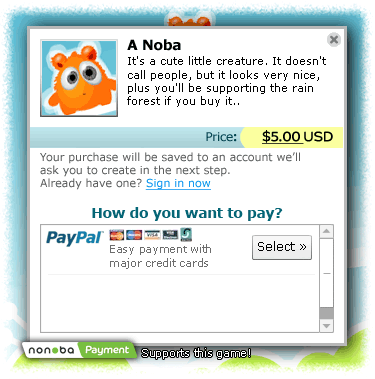
In case you don’t know it, the guys over at Nonoba.com provide a payment engine for flash. From what I understand it is a library you can just plug into your flash game to allow people to buy in-game items with real money.
http://www.nonoba.com/developers/payment/overview

It is quite tempting not having to go trough all the hassle to setup a payment system and just use such an off the shelf solution. However I find two things rather discouraging:

  • 30% Revenue cut for Nonoba. Dude, this is serious money. My Ultimatum Game instincts start to tingle.
  • 5$ minimum payment for Paypal transactions. This is again apparently because Paypal also takes a cut and Nonoba wouldn’t make a profit below that.

So although very intriguing, I found myself struggling to develop a plausible scenario with that system. I could imagine developing a small flash game and sell an expansion pack with some really challenging levels for people who really liked the basic game but would people pay for a 5$ “level pack”? Does anybody have experience with that kind of revenue model? What do you think will happen?

Adult content is not content for adults

Recently, my dad sent me an awesome present from poland (my home country). It was a package with ALL the comics of my favorite polish comic book series “Tytus Romek i Atomek”. I don’t think it was everytranslated into a different language so most likely you don’t know it. Too bad, because it is made of pure win! It is a story of two pathfinders and one monkey (chimpanzee) having a series of crazy adventures. Each episode (or “Book”) is about a certain theme. So you have an episode about sports, one about space, one about art, one about western movies etc… Also, almost every episode features a crazy vehicle. Most of the time, the vehicles look like scaled-up everyday items: a video camera, a flatiron, a guitar etc… It is the comic I grew up with and reading it again I was struck by the sheer density of awesomeness it provides. One book might go something like: a professor provides the thee guys with a vehicle capable to drill into earth. After some funny testing results they learn some interesting geology facts, have a crazy chase in a museum, drill into an old coal mine to find plant fossils, drill further to find a giant mole, drill to the other side of the world where the monkey steals bananas, dill further to discover an ancient civilization that was cristylized in a catastrophe, drill further to empty an oil reservoir and pull a prank on an oil company, drill further to discover an underground empire of technologically advanced dwarfs, get captured and shrunk by the dwarfs, do an excursion on the surface in the shrunk state, fight against insects and birds, get chased by a lizzard and eaten by a snake, break out of the snake, escape the dwarf empire and return to normal size again. All of that only on 62 pages. And it’s just the rough outline. And it’s funny too.

So anyway here is one of my favorite pages from that particular book:

Tytus on Adult Movies

Tytus, the chimpanzee is always up to no good and decides to use the drilling vehicle to get into an adult movie which turns out to be quite boring. I love this one because asides from being funny, it illustrates an important point. I think it was Dennis Ray Vollmer who once said in a discussion on Spielkultur (roughly translated):

Game designers often confuse content for adults with adult content.

What he meant was that even though some content (sex, gore) might not be suitable for children, it doesn’t mean that adults automatically enjoy media full with that kind of content. However, until now game designers often fell for that fallacy and tried to show off the maturity of their medium by focusing on adult content. After all, if there is gore this can’t be for kids, right?

Well bullshit. Because excessive adult content is typically not attractive for adults. It is however attractive for adolescents, who (like games as a medium) are keen to prove their maturity. In fact, you will consistently find that it is often the adolescents who provide and consume most of the adult content available on the Internet. True content for adults often looks pretty boring for children and especially for adolescents. And this is what this particular page is about.

Fishing in the big pond

You know what time it is? It’s statistics time! Oh yes, it’s business time! Look what I’ve prepared for you:

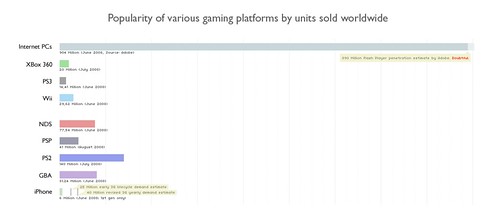
Popularity of various gaming platforms by units sold

Because of the console wars, the various manufacturers started to publish data about the units sold on a regular basis. Somewhat weird. There is competition in other industries as well but finding actual data on units shipped for cellphones or cars is much more difficult then in the games industry.

Anyway, I took a few minutes to grab some of the numbers and visualize them to better understand what’s going on. The idea is to try to answer the question “How many people can I hope to reach if I choose a specific platform”. So here are some of the findings:

Continue reading “Fishing in the big pond”

Photosynth is out!

Note to self: must rethink my RSS feeds. Somehow I managed to miss the launch of Photosynth. So finally, the software that inspired Illucinated, my upcoming game is out. It is a software capable to create browseable 3D Collages out of collections of photos. Kinda like Autostitching but the result is not a single photo. Instead the source photos are arranged in 3D space and the user can move the camera form one photo to another. Really hard to explain, I suggest you experience it yourself if you don’t know it yet.

What I like about it is that they decided to make it available for free. This is a smart move when you consider how the web works.

However, besides this the software is quite a disappointment right now. First, the stitching quality is really poor. Working on Illucinated I had already a huge database of theoretically synth-able photos. I loaded them up in Photosynth but the software fails to assemble even the simplest locations. It seems like they expect you to get A LOT of coverage of the locations. You need several photographs of every spot from different angles. My experience with Illucinated is that doing this is really difficult. When on-location you tend to loose track of what you already photographed and what you are still missing. This is already true when creating photos for stitching. Photosynth requires you to get EVEN MORE photos and I don’t see it happening. You can certainly throw out the idea out of the window that you could take you vacation photos and synth them: it won’t be enough coverage.

I mean, here is a Synth of the Gaming Setup I was talking about recently. It took a whooping 58 Photos and it still just 75% “Synthy” (Whatever that means). If you go to the 2D Overview you will see that most of the close-ups haven’t been registered. And it is still the best one I had.

The second problem I see is that you can’t manipulate the Synths to fix problems. Basically, all you can do is to cross your fingers. If something comes out fucked up, you need to redo everything. Which can take half an hour or more. That’s quite frustrating. I imagine that they will add some advanced features later on. I can even imagine they will charge for those features.

Finally, you need the a browser plugin to browse through the Synths. Why? I understand how you need a plugin to create them but expecting users to install yet another plugin to merely see the content is quite the stretch, especially since Microsoft already struggles make things like Silverlight spread. It would haven been an excellent opportunity to combine the two plugins. Photosynth could have been the Silverlight killer-app. But instead I’d rather refrain from creating Synths because I know that only a fraction of my users will jump through a bunch of hoops just to see my holiday photos. In fact, even my family won’t be able to see my synths because they process of installing Photosynth is just too complicated.

And then I can’t link it to Flickr, users can’t merge their databases, and and and. It might get better with time but right now it is not more then an interesting, troublesome, geeky toy. When you consider the last web app from Microsoft, the rather disappointing World Wide Telescope: It’s deja vu all over again.

Game Designers like Space

What do game designers do when they are not designing games? Well, it turns out that a surprising amount of game designers are actually into manned spaceflight. So far, I could associate three popular game designers with the space industry:

Richard Garriott – is currently at the ISS conducting some privately-funded space experiments. He will be the fist private astronaut to perform a space walk. An interesting fact is that his dad was an astronaut too. Also, this doesn’t seem the first extravagant science adventure the Garriotts perform, as this video shows.

Will Wright – doesn’t actually fly into space but has keen interest in space technology. He collects space junk. According to Wikipedia his collection includes “a 100-pound hatch from a space shuttle, a seat from a Soyuz… control panels from the Mir, and the control console of the Soyuz 23, as well as dolls, dice, and fossils.” Will also builds robots for Battle Bots and won an illegal coast-to-coast race in a tricked-out Mazda RX-7. (Oh my god, these are EXACTLY the things I would do if I had the money, right down to the car manufacturer. Spooky.)

John Carmack – wants to go to space but he wants to do it all by himself. From the three, I would say this one is the most ambitious space-geek. He actually started a company to develop a private vehicle capable to reach space. The company is called Armadillo Aerospace. They even participated in the Ansari X-Prize but obviously lost to Space Ship One. However, since then they have been successfully building up rocket-science know-how and now provide the rocket engines for the upcoming Rocket Racing League. And they didn’t give up their spaceflight plans yet. Though their planned vehicle is somewhat… unorthodox.

So there are just three – big deal? Yes it is! If you consider how small the private space industry is and how little famous game designers there are.

Searching for the Perfect Gaming Setup

So I’m back from being busy. I got into some trouble with my flat. I had to move, buy furniture – the usual stuff. I’m totally spent right now, I could use a vacation. But now is not the time for that – got to move on. The good news is that I’m finished moving (almost) and I’m planning to do regular posts again.

Today I would like to talk about a rather curious problem I’ve encountered while moving: The (Holy) Search for the Perfect Gaming Setup. Everybody, who seriously deals with Videogames sooner or later has to consider how his area of interests affects his dwelling (by the way: what’s the correct translation of the German verb “Wohnen”? “Dwelling” sounds like something cavemen do. Argh!). So after you collected an impressive collection of consoles and games you will want to tuck them away so you don’t trip over wires every time you grab a cookie from the kitchen. Yet, they need to be accessible anytime you feel the urge (or duty) to save the world again.

Gaming Setup From Afar

I came up with this one and I’m pretty satisfied with it, even if it is not quite perfect. Here are some of the thoughts I had, some difficulties I had to face and how I solved them:

Continue reading “Searching for the Perfect Gaming Setup”

Excit Clones

The Success of Exits never fails to amaze me. Back when we made it, we only hoped it would spread virally. Actually, the briefing was to create a viral game. But viral marketing is a tricky beast and the results aren’t predictable so it felt more like a stab in the dark.
But we hit something after all and Excit had more then 2 Million Plays. Even today we get around 3000 hits a day. We were paid for the game itself by the client and we even made some change with ads. How ironic that the game is more prevalent then our client. The project was so successful that I consider flash games as a means to earn my money.
Recently, some people started to contact me to show me their Exict clones. I must say that I really enjoy seeing them. Having people play your game is one thing but seeing how your work inspires people to follow your steps is a whole different ballpark. So here is a list of the Excit clones that came up so far:

Excite (not a well chosen name) is a clone of Excit in C#. It seems like this one is in an early phase of development yet. At this stage, it lacks a lot of polish but it already comes with some interesting features. For example, it introduces “harmful” blocks. Back when we made Exit we decided against them to simplify the rules (only one game over condition). They do allow some different level designs, though.
Unfortunately this clone also shows quite nicely the advantages of Flash as a game platform: no installing, no compatibility issues – it just works, right here right now.

Spreadsheet Escape came out recently. Visually, this one is obviously Excit-inspired but there is a nice gameplay twist: the cursor stops “inside” of walls rather then in front of them. Walls also become passable after the cursor hit them once. I really like it because of this small difference. Too bad it lacks so much polish, I wonder what kind of impact this difference has on level design possibilities with a higher difficulty.
It is also interesting how the author has to endure a lot of flames on the Kongregate comments for “ripping off Excit”. In fact, all of them do. Even we had our share of that because of similarities of Excit with Orbox and Roadblocks. Isn’t it strange? Why is this considered a bad thing with this kind of game but no one complains when yet another Tower Defense game comes out? It seems like there is a certain resistance to clones if the genre is not well established yet.

Target is one I found by accident by checking comments on Spreadsheet Escape. The level of polish is somewhat comparable to Spreadsheet Escape, unfortunately. However, what I like about it is how it features a look and feel similar to Excit without explicitly adapting its spreadsheet theme.

Traction 2 is the oldest ones we found. Technically it is not an Excit clone. The Author claims that he never saw Excit. If this is true, the similarities are uncanny. Either way, Traction 2 is the most polished one. The graphics and animations are simple, crisp and functional. The the controls are responsive, the Interface is well thought-out. My personal favorite is the typography – I have a thing for Futura. So why does Excit outrank this one by a factor of 100 on Kongregate? What do you think?

That’s all for now. If you found a game that was clearly inspired by Excit, please tell me!

If you want to make a game similar to Excit – I don’t mind. On the contrary: by all means, go ahead! Just tell me if you finished. And it wouldn’t hurt if you could link back to Excit.

Spore Alternatives: Q-Pop

Q-Pop Evolution

With Spore having some troubles and being not exactly the most complex game, I would like to point out very quickly a neat alternative: Q-Pop. The game is VERY old. I think back from something around 1995. It is also technically not the most amazing one. It is partly turn-based, you can’t customize the appearance of creatures, it’s obviously not online and it only covers the creature stage of Spore. On the other hand, it has more strategic depth then Spore. You can change the attributes of your creatures and they DO affect the survival rate of your species. You can also play it multiplayer at a single PC and the best part is that it is free and only 2,5 MB in size (the game is avalible only in German, sorry).

Spore Problems Piling Up

I think everybody was at least curious how Spore would turn out. Now it seems that success of the highly anticipated game is heavily tainted by some draconian security measures.

There was a big outcry because of the DRM system SecuROM being implemented. The system was especially tight: it would have to “validate” an installed version of the game every 10 days online. This was – of course – a problem for those who couldn’t go online regularly so the system was changed to its current form and it is not better. Now you validate the game only once but you can do it only 3 times in total. And you loose a validation every time your hardware configuration changes. After you’ve lost all 3 validations, you can’t play the game anymore. You can however gain a validation back if you un-install the game before the system configuration changes. This is a bad idea for many reasons, obviously. One which I think is particularly important is that you can’t really re-sell the game after you’ve bought it because the buyer can’t be sure how often the game was validated.

But there is more: it seems like you can have only one online account per CD-key. This is especially inconvenient for families (major target group?), where different members of the family play the game and want to post their creatures independently from each other. To add insult to injury, the European handbooks incorrectly state that you could have several online accounts.

It seems like the problems pile up. As I’ve already pointed out, the amazon reviews are flooded with anti-DRM rants (it’s over 2000 now – ouch!) and I can hardly blame them. I would expect that implementing effective and non-invasive anti-piracy measures shouldn’t be a problem in a game where a vital part of the joy comes from playing online. Am I missing something? It is a shame seeing how the obviously game suffers from these problems. Considering how there is already a perfectly working pirated version out there, I do hope EA gets the clue.

Mooments of Truth

MooCards customer service

Moo is awesome! Seriously. You might remember that I’ve ordered some Moo Mini Cards and I wrote a small article judging their quality and mentioning how the edges weren’t cut as smoothly? Well, imagine my surprise when I got an E-Mail from Moo apologizing for the quality issues and informing me that they will send me another batch of my Moo Minicards to set it straight. Wow! Impressive customer service. I didn’t even send them anything. I guess they are constantly scanning the interweb for comments on the quality of their products.

This made me Think:
Continue reading “Mooments of Truth”

About

The Game Design Scrapbook is a second blog of group of three game designers from Germany. On our first blog, Game Design Reviews we describe some games we played and point out various interesting details. Unfortunately, we found out that we also need some place to collect quick and dirty ideas that pop into our minds. Hence, welcome to Game Design Scrapbook. You will encounter wild, random rantings. Many of then incoherent. Some of them maybe even in German. If you don't like it, you might enjoy Game Design Reviews more.

Twitter

follow Krystian on Twitter
follow Yu-Chung on Twitter
follow Daniel on Twitter