Learning Japanese

I started learning Japanese. It was a weird coincidence. First I was listening to a couple of podcasts from people living there. This primed me already for the topic. Then I couldn’t resist buying a certain book on a certain game I enjoy very much. That book was actually in Japanese so in order to justify the purchase, I felt obliged to at least try to understand it. Finally, my girlfriend asked be why I never learned it.

And it’s a good question, too. I think learning a language only makes sense if you have enough opportunities to get exposure to the language. So for example, learning Spanish wouldn’t make much sense in my case. I would need to deliberately make an effort to get me into situations where I would need to use the language – go on vacation to Spain, read Spanish books, etc. After all, you can’t just learn a language and let it sit in your head. A language needs maintenance. As it happens, my current lifestyle doesn’t provide much opportunities for a language like Spanish but provides lots of opportunities for Japanese. I play a lot of games from Japan. I also used to read quite some comics from Japan and I was fond of Japanese animated series. Considering this, it’s weird that I didn’t do it before.

But then again I’m not a big language learner. Especially not in the traditional sense. So I thought I keep it low-profile. I took an advice from a professional and started with the alphabet first, specifically Hiragana and Katakana. Also, I didn’t buy books, I bought apps instead.

It seems like a good starting point is the iKana app for iPhone. It is a beautiful, polished and comprehensive directory of all Hiragana and Katakana characters. There are also functions to practice the recognition of selected characters and even a simple quiz for learning how to write them. It’s a perfect tool for practicing the alphabet.
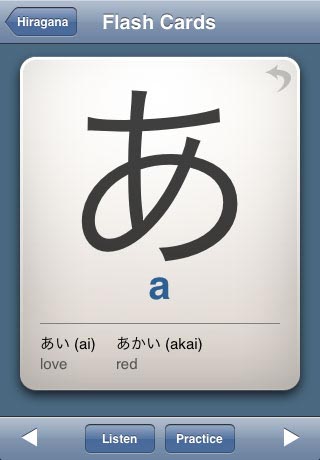
iKana

But the problem is that it is not a very good tool for learning them in the first place. As a newcomer, all charters looks the same to me. I need at least some guidance to get started. So I got myself one of the HiKaChan apps. They are actually not very good. They are ugly, the UI is bad. Some functions are poorly executed to the point of being useless. And they have less content than iKana – you need to buy an app for Hiragana and a separate app for Katakana. However, they do have one big strength. Each character is introduced by comparing it to an image – a so-called mnemonic device. The pictures are far from perfect. Some are quite a stretch and they often rely very much on the fucked-up english pronunciation (”i” like an “Eagle”??). However, even this small help goes a very long way for a newcomer to get familiar with the characters.
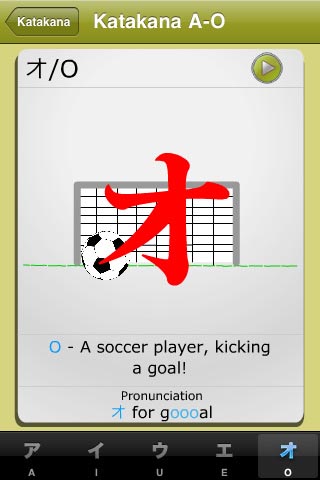
HiKaChan

So my current setup is to learn the characters in HiKaChan and practice them in iKana. It’s going to be a long journey but I already had some sense of achievement. I was able to “read” a couple of words. I’m going to keep you posted on my progress.

Why the Wii Hate?

Why do so many game writers hate the Wii so much? There are certain expressions always associated with the system and it’s games. “It looks good for a Wii title” they say. Or even better: “Time to dust off my Wii”. There is this myth that Wii somehow has no interesting games for “true gamers”? What’s wrong with you people?!

Recently, we have been doing regular screenings of trailers for interesting new releases at Cologne Game Lab. I noticed that a significant portion of the interesting games were on the Wii. Also, we also organize a little multi-player session afterwards. More often than not I will be inclined to reach for the Wii exactly in those situations. Finally, when people ask me what console to get if they want to get into gaming, the Wii is often ends up being a very tempting choice – not only because of the price.

It is true that I stopped playing the Wii for some time after I got the Xbox 360. There was an entire different world of gaming for me to explore. But recently, I found myself coming back. Here are some fascinating recent and less recent Wii exclusives. I believe they alone justify to take the platform seriously.

  • Muramasa: To be honest, this is the trigger for this article. I just got the game today and it blows my mind. It looks amazing. The combat may lack some depth but the breath-taking visuals and the cultural references will keep me going for a long time. And then some.
  • Monster Hunter Tri: It has been a long time since a game made me as addicted as Monster Hunter. Luckily, it’s a well-made game too. It is not perfect but if you happen to be the kind of person that enjoys this kind of gameplay, there is no coming back.
  • Silent Hill: Shattered Memories: Yeah I know. It’s also out for the PS2. But let’s face it – the Wii Version is the definitive one. Again, one of the most innovative and mature titles I have seen for quite some time. Good writing, risky gameplay decisions. This is the game that totally distracted be from all the Alan Wake hype.
  • Super Mario Galaxy 2: It’s rare for a title to get so positive reviews from all sources. It’s ever weirder if you consider this is a direct sequel. It even doesn’t look much different from the first part. So clearly, there is something special going on. What am I still doing here?
  • Shiren the Wanderer: Here is a curveball. It’s a roguelike with very intricate mechanics and graphics that aren’t ASCII. When was the last time you saw a roguelike on a mainstream console?
  • Okami: Again – yes it started out as a PS2 title. However, because of the gesture-based controls it looks like it was made for this System and the Wii Version is the only one I would consider trying today. The game features innovative controls and unique graphics. Otherwise it copies Zelda, one of the most addictive and best established game formulas. Nuff said.
  • Red Steel 2: I’ve played it very briefly at GC and I liked it a lot! It a unique take on FPS games with a new, polished control scheme an a very cool visual style.
  • Metroid Trilogy: Somehow this is often swept under the carpet when discussing the Wii. It seems like it is taken for granted. But it’s not! It’s one of the most amazing FPS experiences out there. And it’s exclusive for the Wii. Deal with it!

I could continue like that mentioning things like Madworld, House of the Dead: Overkill or Deadly Creatures. I could even go into the big sellers like New Super Mario Brothers Wii or Wii Sports Resort. My point is that there is no reason to hate the Wii. It is home to some of the most exciting titles of this generation. And it is also selling like crazy. :)

Exploiting the Supernatural

There is something very specific about the Prince of Persia movie that bugged me. It actually fits well to the recent Experience Points Podcast where I was the guest. Or more precisely, the GDC talk by Chris Hecker on Finishing Games.

Prince of Persia is a story that centers (or should center) around a supernatural artifact. The prince obtains a dagger that can rewind time for a few moments. However, as I already mentioned the device is not used very often in the movie. But even when they use it, the characters never try to exploit the power this artifact gives them. The dagger is mostly used in the way it’s “intended” to be used. The blurry fringes of the rules that govern it’s power are never explored.

To understand what I mean by that, we need to take a look at a different piece of fiction where characters actually do exploit a supernatural artifact. Let’s talk Deathnote.

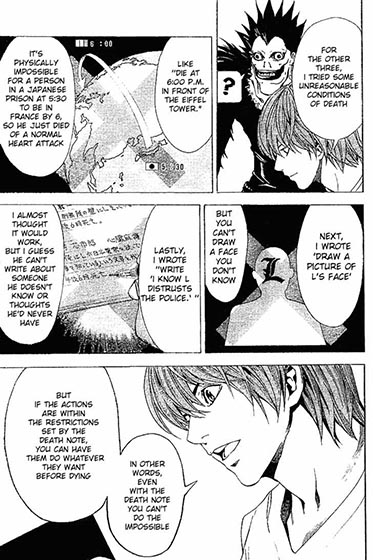
Deathnote is a Manga and an Anime where a teenage protagonist obtains a magical notebook. Every time he writes a name in that notebook, that person will die of a heart attack shortly after. The notebook’s owner can even specify a custom death cause and death circumstances by writing them in the notebook as well.

When I first heard that story, I was wondering what kind of drama would unfold around such an artifact. The notebooks seems so tremendously powerful that it’s owner shouldn’t encounter any adversaries or difficulties. So when I read the Manga, it pretty much blew me away. The story depicts a sort of a duel between the protagonist and a very smart super-detective. Even though the protagonist can kill people without leaving any evidence, simply the choice of his victims is enough for the detective to find out a lot about the murderer. Things get even more dramatic later on where the detective stages various traps and tests to determine the murderer’s identity. It’s a magnificent and well-thought out demonstration of deduction skills and logical thinking.

I’m mentioning this because the protagonist in Deathnote has a very peculiar way of dealing with the notebook. Instead of using it as it is “intended”, he actually does a lot of experiments with the notebook’s powers. One of the early experiment is writing the cause of death first and filling in the names later. Later he also experiments with “impossible” death circumstances or with the level of control he has over the way the victims die. He ends up even tearing pages or individual paper strips from the notebook so he can use them more inconspicuously. The very simple rules of how to use the notebook become a fascinating playground for the most macabre experiments. It’s a magnificent example of the author not being afraid of eventual inconsistencies of his own supernatural rules. On the contrary, he uses and explores them to their full potential and creates a surprising, smart and thrilling plot in the process.

Deathnote

I have the impression that especially western authors are afraid to go that far. Prince of Persia is an example. There are a lot in paradoxes the dagger’s powers could create. In one scene the prince gives the dagger to one of his brothers. The brother uses the dagger’s power to rewind to a time where he didn’t have the dagger yet. Weird enough, when time started flow normally again, he was holding the dagger in his hand, not the prince. So he not only used the dagger’s power to rewind time, he also magically transported the dagger from the prince’s hands to his own. What if he would rewind to a time when he was holding something else? What if he would rewind to a time when the prince using the dagger to rewind time? Or how about rewinding to a time when the dagger was used to stab somebody in order to prevent the stabbing simply by the act of rewinding? There are many other ways this could go. My point is that the movie never explored those questions, which is a pity.

Apart from being an exciting way to surprise and challenge the audience, doing such supernatural exploits also has an underlying message. It presents characters who do not simply obey rules and laws, even if they are of supernatural origin. It presents characters who take matters into their own hands, who use their brain and shape their own destiny, even when it means to defy gods. This moral is in line with the most fundamental change in storytelling of the last 2000 years. It’s time we stop going back to old fairy-tales and start thinking things trough. I’m looking at you, LOST! >:(

The Prince of Persia Movie

Here be minor spoilers, but what the hell are you saving yourself up for?!?

I saw the Prince of Persia movie. Executive Summary: It’s just like every other videogame movie. It may be one of the better ones among the videogame movies. But it’s still simply not a good movie.

It’s surprising too. For example, it is one of those movies where there would seem to be plenty of opportunities for iconic environments and deep characters. Both of which made Pirates of the Caribbean so successful. But instead we only get a load of missed opportunities.

Case in point: the prince. He is supposed to be a streetwise kid, who was adopted by the king. The movie tells us that the king was impressed by something the prince did when he was living on the streets. He rebelled against a guard to save a friend. But when you think about it, it doesn’t seem like anything exceptional. Being cocky and rebellious is what street kids do. Why would the king be impressed by that so much?

But nevermind that. In the first scene where we see the prince grown up, he is involved in a fight against a seemingly stronger opponent. There is a bet going on. The prince is aware that he might lose. He drops a cocky one-liner, starts another attack and… loses. And that’s pretty much the introduction. When I saw this at cinema, I was stumped. What was the point of this scene? Shouldn’t this go differently? Shouldn’t the prince use his wits to out-smart the stronger opponent? Or maybe his acrobatic skills? Or how about making him realize that he lost because he couldn’t foresee the moves of his opponent? It would make the power of rewinding time more meaningful later on. Why did they miss this perfect opportunity to characterize the protagonist? Did the writer fall asleep while he was writing this?

And if you think this is bad – the princess is even worse than that. We know nothing about her, only that she is a hottie and she turns out to be snappy and rebellious without any clear reason why.

I know the setup is well-known but a good movie would at least try not to depend on the audience’s knowledge of typical adventure movie clichés. The audience shouldn’t be expected to make up for the shortcomings of exposition.

But where the movie REALLY falls shorts is in the environments. A Prince of Persia movie sounds like it would be perfect for scenes where the heroes would perform mind-boggling acrobatic stunts in well-defined, iconic locations. What we get instead are bland, repetitive and uninspired scenes. They are poor at conveying a sense of space, size or layout. Whenever there are acrobatic stunts, they boil down to confusing jump cuts and shaky camera. This is not a movie where you are supposed to understand what the hero is doing or where. It is a far cry from the perfectly choreographed action sequences of Pirates of the Caribbean.

And finally, the plot itself is just full of holes. The prince spends most of the movie convincing his brothers that he didn’t commit a crime he is being accused of. Each of his brothers gets murdered shortly after being convinced by the prince. So all of the prince’s actions are meaningless. That makes for rather dull cinema.

The climax is especially confusing. Because what basically happens at the end is exactly what the prince and the princess are trying to prevent the whole time. So it’s not really clear what they actually achieve.

The movie’s gadget, the time-rewinding dagger is used meaningfully only twice in the entire movie. The movie fails to reflect the concept of time in it’s themes. Instead we get characters dropping some corny lines about “following you heart” or something. What does this have to do with anything?!

My favorite videogame movie is still Resident Evil. The first one. It’s not a better movie by any means. But it’s honest. It’s not trying to be more than a fun, silly zombie flick. It lives up to it’s full potential. Prince of Persia doesn’t.

The Blank Page Problem

Working creatively is very different from working manually for example. The problem with creative work is that you will waste a lot of time. Most of that time you spend doing nothing. For me I fond this is often because of the Blank Page Problem.

You might be familiar with the situation. You know you need to do something. But you never even get started because there is nothing there yet. So it’s difficult to figure out what to do first. There are too many possibilities and it’s difficult to decide what to do. On top of that, the sheer amount of work in front of you is discouraging. So you start dancing around the problem. You start doing simpler tasks, which may or may not have anything to do with you actual project. You might clean up you desk instead. Or clean up your mail in-box. And if you don’t play attention you end up doing what you fear most: PROCRASTINATING.

When I already started a project, it is much simpler. I arrive at an unfinished piece. I can start by checking out the stuff I have so far. I will immediately see the parts I want to work on. And suddenly I forget the huge amount of work in front of me and lose myself in the task at hand.

I had big trouble getting back into TRAUMA development specifically because of the Blank Page Problem. The game was at a point where figuring out the next step was difficult. I had a big break since the last time I worked on it so I lost my train of thought. And there was always other things to take care of too.

My solution was to reserve an entire day to jump start development. If I have anything planned on a day, especially in-between, there is a good chance that I won’t get anything done. I often arrive at a point where it seems like it makes no sense to continue because I would have to quit soon. Actually, it’s quite like in the video above.

However, if I have an entire day there are no excuses. And indeed, I successfully returned to developing TRAUMA.

The trick now will be to keep working on it regularly. At least an hour a day. I don’t want to lose my train of thought again and arrive at a Blank Page situation. I need to finish this.

Kernel Panic Podcast

Two exciting pieces of news. First I was invited to the excellent Kernel Panic to do an episode with them. It is a show on Apple and Apple related things and both hosts currently live in Japan. I spoke a bit about my experiences with Apple products. I also threw in some bits to the Apple vs. Adobe discussion.

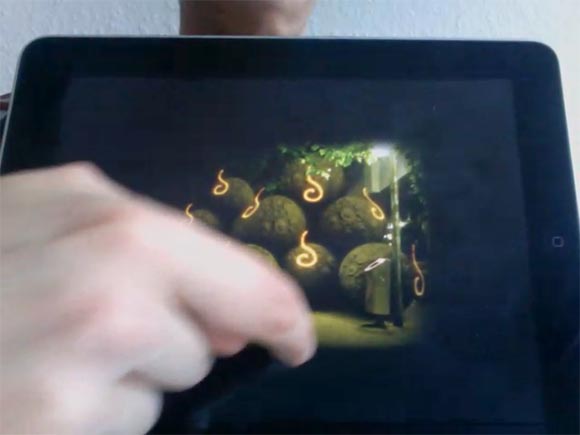
I also revealed for the first time that I am indeed experimenting with ways to bring TRAUMA on the iPad.

iPad Trauma

This is not fake, I promise.

I have teamed up with an extremely talented iPhone / iPad developer form Cologne. He is currently working on a first prototype. We are making progress. There are some interface challenges because TRAUMA wasn’t developed with a touchscreen in mind. We discuss some of the problems in the Podcast.

I had a great time with the guys from Kernel Panic and I strongly recommend it to people, who use any sort of Apple products.

Space Map in 3D

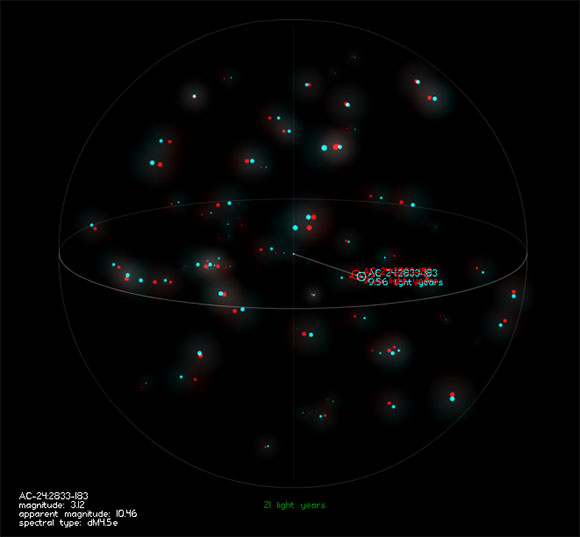
Here is a real treat for those of you who enjoyed my space map of the 32 nearby stars. The independent developer Loren Schmidt whom I’ve met at the Independent Games Festival recently did experiments with a very similar map. Now he managed to James Cameron it. Get your 3D glasses out!

3D Starmap

I love it. I have been playing with that idea for some time and now he beat me to the punch. I enjoy that we do have slightly different approaches on the information design of our maps. It is an inspiring experiment. I might go ahead and do a 3D version of my own map. That puppy is ripe for an update.

Almost Lost

Short update today. As you might have heard, the TV show Lost is drawing to an end this weekend. It almost feels like a significant moment in history – the end of an era. As many others, I have been an avid follower of the show for quite some time and I am looking forward to the finale.

However, even though I think the show had a great start, my fascination of faded over the years. Lost is a show that strongly exhibits one particular characteristic of most modern works of fiction – the over-reliance on hidden information. The fascination in Lost stems from the many things that the writers hint at but hold back from explaining – the secrets and mysteries. There are two problems with that approach.

One is that the entire story is dominated by the final reveal. Many stories which use this technique often lose all attractiveness once the secret is revealed to the audience. It seems like increasingly more and more stories in games and movies hinge so much on this final reveal. We even established an entire etiquette of dealing with the reveal of hidden information when discussing the different works of fiction – the spoiler alert. It is evident that the enjoyment of a show hinges on the fact that certain information is revealed at a specific moment. I understand the appeal. However, I believe that a good story shouldn’t rely on cheap tricks like this. A good story should remain attractive even when the audience knows how it will end.

And the second thing is that specifically Lost exploits that effect of hidden information to a worrisome extent. The writes of the show make the mysteries up as they go. They hint at mysteries they have to solution to yet. The idea of the storytelling is not to make a certain point. The idea is to use every trick to hold the attention of the audience as long as possible. In the end it is simply a very manipulative and exploitative approach.

As far as the finale goes, I am bracing for a monumental disappointment. The few last episodes already took a turn in a direction I find most dull and uninspired. I guess it was inevitable. So I am afraid the show won’t age well for me after all.

If you are interested in the process of how the show is written, I recommend two panel discussions with the writes on the Creative Screenwriting Magazine Podcast (Part1 and Part 2). I found the panels interesting but they pretty much confirmed by concerns about the show.

The Trojan Math Challenge Progress 2

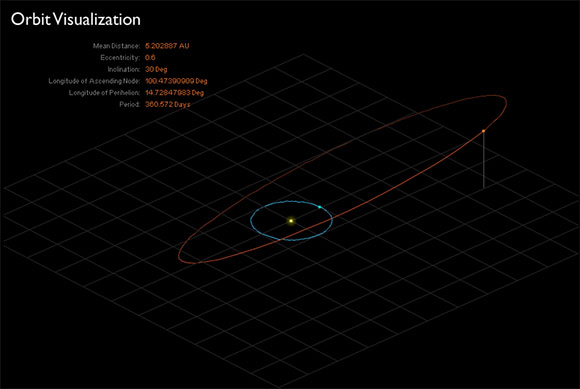
I finished a first experiment. I think I have the code for the orbits almost done. It’s still very slow and user-unfriendly. But you can change the orbit of the orange planet already.

Orbit Visualization

If you are interested, the function I was looking for goes almost something like this (AS3 code):

public const TORADIANS:Number =  (Math.PI / 180);

public function stateVector(t:Number, o:orbit):point3D {
	// Calculates the State Vector (xyz coordinates)
	// of an object in an orbit at a given Time
	// The coordinate system is Heliocentric
	// and aligned to the eclyptc

	// t - current time (in days)

	//o.e - Eccentricity (degrees)
	//o.a - Mean Distance (Astronomical Units)
	//o.i - Inclination (degrees)
	//o.O - longitude of ascending node (degrees)
	//o.w - longitude of perihelion (degrees)
	//o.P - Period (days)

	// Define some Variables to work with
	var myX:Number;
	var myY:Number;
	var myZ:Number;
	var M:Number;
	var V:Number;
	var r:Number;

	// Choose a Mean Anomaly
	// This is due to change
	// Right now, all Planets start at 0° at t=0
	M = ((t / o.P) - int(t / o.P));
	M = M * 360;

	// Calculate True Anomally
	V = getTrueAnomaly(M, o.e);

	// Calculate Radial Distance
	r = (o.a * (1-o.e*o.e)) / (1 + o.e * Math.cos(V * TORADIANS));

	// Transform Orbital Coordinates into
	// Heliocentric Ecliptic coordinates
	// Sin / Cos values are pre-calucated to save redundancy
	var sinWV:Number = Math.sin((o.w+V)*TORADIANS);
	var cosWV:Number = Math.cos((o.w+V)*TORADIANS);

	var sinI:Number = Math.sin(o.i*TORADIANS);
	var cosI:Number = Math.cos(o.i*TORADIANS);

	var sinO:Number = Math.sin(o.O*TORADIANS);
	var cosO:Number = Math.cos(o.O*TORADIANS);

	// Calulacte Carthesian Coordinates
	myX = r * (cosO*cosWV - sinO*sinWV*cosI);
	myY = r * (sinO*cosWV + cosO*sinWV*cosI);
	myZ = r * sinWV * sinI;

	// And that's where the Planet is
	return new point3D(myX,myY,myZ);
}

public function getTrueAnomaly(M:Number, e:Number):Number {
	// Approximates the True Anomaly (V) from the Mean Anomaly (M)

	// Set constants for precision approximation
	const TOLERANCE:Number = 1.0e-12;
	const MAXAPPROX:int = 80;

	// Some Variables
	var E1:Number;
	var E2:Number;
	var V:Number;

	// Convert from Degrees to Radians
	M = M * TORADIANS;

	// First calculate the Eccentric Anomaly
	// Get a first approximation for the Eccentric Anomaly
	E1 = M;

	// Start iterating to calculate a closer value
	var loopCount:int = MAXAPPROX;
	do {
		E2 = E1;
		E1 = M + e * Math.sin(E2);
		// Quit loop if close enough or running too long already
	} while (Math.abs(E1 - E2) > TOLERANCE && --loopCount > 0);

	// Now convert Eccentric Anomaly to True Anomaly
	V = 2 * Math.atan(Math.sqrt((1+e)/(1-e)) * Math.tan(E1 / 2));

	// Convert back to degrees
	V = V / TORADIANS;

	// And that's the True Anomaly
	return V;
}

I still need to tie the place in orbit to a REAL time and date. That problem is related the the last post. But now that I got a prototype, I should be able to experiment to figure it out. I will also improve the performance and interface so people can use this app for their own experiments.

The Trojan Math Challenge Progress

I received some info to solve my Trojan Math Challenge. But the deeper I go into the rabbit hole, the more frustrating it gets. I haven’t even got to try the formulas I found. So far I’m still struggling with the fact that different sources work with different data.

One of the values I need to have in order to introduce the time into the equation is the last date at which a certain object (asteroid or planet) was at its perihelion. The perihelion is in this case the moment where the object is nearest to the sun. The JPL Small-Body Database Browser gives a time of the perihelion passage in JED (days since 12:00 January 1, 4713 BC). I can use that and the orbital period (day to make one orbit) to calculate the last perihelion with ease.

So I have all the data I need for the Trojans. BUT I also need Jupiter. Actually, I want to check my program with the Planets first before I move on to the Trojans. Unfortunately, I can’t find the next perihelion passage time for Jupiter or any other planet. Neither the Jupiter Fact Sheet nor the JPL data sheet list that. You would think that there is MORE data on the planets than on some dinky asteroids.

Wolfram Alpha says Jupiter’s last perihelion was May 20, 1999 but that seems to be somewhat imprecise. I would feel better having a JED value.

Weird enough, the Jupiter Fact Sheet gives a Mean Longitude for Jupiter (34.40438). I have no idea what time this is referring to. I guess it’s not the current Longitude as the page looks static. So it could be the Longitude at J2000, the currently-used standard epoch, defined by international agreement. But if it is, why does the JPL fact sheet give a slightly different Longitude value (34.39644051) aren’t they referring to the same thing?

That’s the same kind of bullshit I run against every time I get into this kind of projects. The last time I wanted to map the orbits of the irregular moons of Saturn and Jupiter and it was simply impossible to determine what plane the inclination values were referring to in the different sources. Sometimes it was the ecliptic, sometimes the mother planet’s equator, sometimes some weird mathematical constructs. You could never really tell. You could also never tell how to derive one from another.

I’m frustrated, I’m going to kill a Great Jagi now.

About

The Game Design Scrapbook is a second blog of group of three game designers from Germany. On our first blog, Game Design Reviews we describe some games we played and point out various interesting details. Unfortunately, we found out that we also need some place to collect quick and dirty ideas that pop into our minds. Hence, welcome to Game Design Scrapbook. You will encounter wild, random rantings. Many of then incoherent. Some of them maybe even in German. If you don't like it, you might enjoy Game Design Reviews more.

Twitter

follow Krystian on Twitter
follow Yu-Chung on Twitter
follow Daniel on Twitter