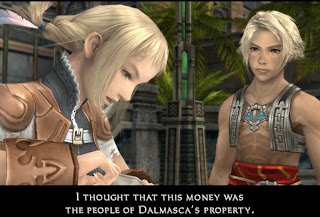
Whenever i thought about or wrote down some of my gamedesign ideas in the last few years, i allways tried to focus on my personal technical abilities or on technologie than can be build with small teams and small budget.
as an example: 3d graphics is okay, but no ik animated objects. this and other limitations allways seemed as if it isn’t possible to create 3d characters with low budget. not from a artist point of view (it’s time consuming to create a high quality 3d character), but from a technology pov (even if it is a simple stylized character, all the technology needs to be fully available).
of course, krystian allways keeps the pov: 2d is more than enough, 3d is not necessary. but in 2d still the problem remains: fully animated characters (full body, complex animations) are one of the most complex game-content types.
but of course a lot of games since the eighties had characters involved, a lot of adventures and rpg’s with very emotional tied characters – and a lot of those games did not have best technical presentations of characters.
a lot of (especially japanese) rpg’s that allways wanted to create believable stories with beliveable characters created their own style of only showing heads, 2 frame talk animations (mouth open, mouth shut), synthetic sounds instead of voice acting, etc.
and now i’d like to start a discussion about what other ways of displaying characters are out there, done by others, liked and unliked by players. it’s really interesting how many stick-figure-like flashgames are popular today, but are their ones in which the player is really tied to the character. i mean action games like “N” have cool characters, but not really tied to the player. what if the N ninja meets others in a rpg/adventure world, other stickfigures – will good textual dialog be sufficient without more detailed visual representation of the characters?
i’d like to ask some more precise questions that we can elaborate or research on:
- how much needs to be visible of a character (head only, including shoulders, torso, complete body from hair to feet)
- in which context does a character need to be presented (floating in a frame ontop of the playfield, text in a adjacent frame, standing on the playfield)
- what kind of other decissions determine if a character should be displayed this or that way
- do characters become alive more by their visual representation, or by their textual dialog? what about simple text “to scroll through” or (fake) multiple choice dialogs?
as an example i like to tell what the schleichfahrt / aquanox series did:
- schleichfahrt (archimedean dynastiy) had simple text boxes in 3d prerendered rooms. but multiple choiced and over 100 npcs. people loved it.
- aquanox had icon-small faces (multiple in a group conversation) attached to a frame in which the dialog text was. no multiple choice, aprox 50 npcs. which hovered onscreen over an outdoor underwater look at a sub-station. people disliked it a lot.
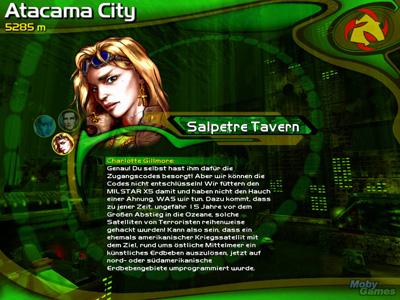
- aquanox2 had jrpg like huge high quality faces (but unanimated!) + upper-torso hovering with text-frame over pre-rendered rooms. less than 15 characters and no multiple choice. people liked the characters a lot. but i tend to belive that this was more due to the good voice acting combined with the high quality artworks, and had nothing todo with the visual representation style.
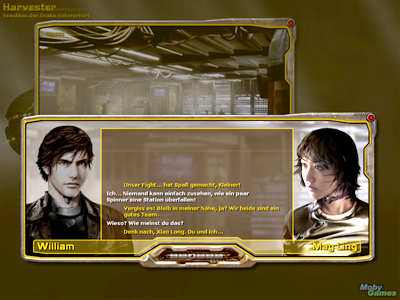
btw: all 3 games have voice acting in a rather high quality – probably another point of discussion should open up on this topic alone, including the half life discussion about talking player characters. the ones in the ad/an series allways did so.
so, i stop writing now and ask: what do you think?