Pro Real ID

You might have heard about the controversy surrounding Blizzard’s new Real ID system. They basically want to set up a Facebook for their games – WoW and StarCraft 2. The controversy started when they also decided to show real names instead of nicknames on the WoW boards. A lot players complained that they wouldn’t be able to use the forums anymore in fear of their personal safety. To be honest, I find this situation quite bizarre. Maintaining a community where the only way to prevent people from physically assaulting is each other is to put everybody under a witness protection program doesn’t seam like a healthy thing to do. If real-life stalking and verbal abuse is indeed such a big problem, maybe we should start thinking about limiting user interaction in WoW in general. From the accounts of the protesters it seems like paying WoW is like taking a vacation in Cueva de Villa Luz (a cave filled with hydrogen sulfide).

Regardless, it looks like Blizzard cave in (pun not intended but serendipitous) and decided to remove the Real ID system from the from the forums. Um, “yay” I guess?

It seems like a missed opportunity. Implementing Real ID in a large forum such as the WoW would have been a great test to test the Greater Internet Fuckward Theory. A lot of the protesters argued that it wouldn’t improve the post quality. On the other side, I think we shouldn’t underestimate the role of anonymity plays in ALL the mentioned problems.
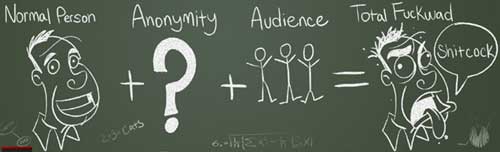
GIFT

Can’t argue with science.

There is another aspect that hasn’t been brought up at all. I guess it’s mostly due to the fact that it’s the WoW players who seem to object the most. However, the reason why I’m looking forward to Real ID is it’s implementation in the StarCraft 2 community. StarCraft 2 will most likely become one of the most important e-Sports games in the next few years. It will shape the global face of the entire scene. In many countries, Germany included, e-Sports are struggling with being recognized as a serious activity. For example, if e-Sports would be recognized as an official sport by the government, e-Sport teams would be able to receive tax subventions. It would be also much easier to organize e-Sport events and media would be more inclined to report on them.

I think introducing Real ID into the StarCraft 2 can vastly improve the quality and professional appearance of that game. If new e-Sport players are bred from a pool of anonymous Internet trolls, it’s difficult to get that mentality out once the players reach a professional level. This has detrimental effects on the appearance of e-Sports in general. Even among gamers, StarCraft’s reputation is not that of a civilized and mature game.
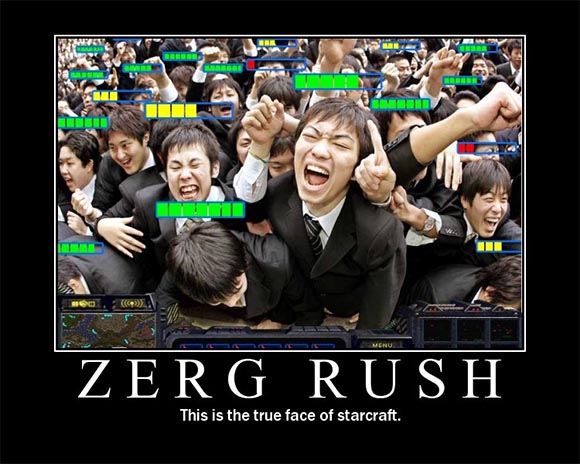
Zerg Rush

kekekekeke!

I think introducing a concept of being a real person competing with others even at a casual level will vastly improve the quality of the StarCraft 2 community. This boost can trickle down on the rest of the e-Sport movement and it’s reputation. It even could become an important step in accepting digital games as a serious part of our culture.

Of course, I do see how this has little to do with World of Warcraft. Considering how Real ID will still be implemented it seems like everybody got what they wanted just for now. GG
They Are Lying to Us

The ongoing oil spill in the Gulf of Mexico is a certainly the a tragic and most disturbing catastrophe. It may very well end up as a 9/11 of this decade but with even more dramatic, global consequences. I often find myself fascinated by the narratives that are woven around it. Oil drilling is technology that is poorly understood by average people. For obvious reasons it’s not easy to visualize it properly. I mean, drilling is already very much about events that occur underneath the earth surface. But that’s drilling on the bottom of the ocean. It would be difficult to imagine a more unaccessible and hidden activity.

So naturally, there are a lot of experts coming in and trying to explain what is going on. And of course, nobody really knows so people start to speculate. And as they start speculating, entire narrative structures are being created. They are fascinating because the subject is new and fresh. So the on one evening I was reading into this article. It is one expert speculating on how the reason why they can’t stop the oil spill may very well be that the entire dill-hole is somehow broken and corrupted. This means that the oil spill may continue for months until the entire reservoir has been discharged into the ocean. It’s a dark and fascinating perspective. It’s deduced from data coming from a wide range of sources. Checking up on all those sources sucked me in so much that was surprised when I realized the sun was rising up again.

And if this is depressing, how about this article. It’s yet another speculation that there might be a huge methane bubble underneath the sea-floor. The oil spill may be a symptom of the sea-floor being on the brink of collapse. When the methane gets released, it will cause a mass extinction on earth, including the end of human civilization as we know it.

As frightening and fascinating those scenarios are, there is one thing they have in common with wacky conspiracy theories. In fact this little detail actually puts them well into the genre of wacky conspiracy theories:

Why is the press being kept away? Word is that the disaster is escalating.

It’s a logical fallacy common to conspiracy theories. It bugs me since it’s obviously silly, yet nobody seems to realize. If an organization would know anything about the world coming to and end, there would be no reason for them to them to keep it secret. Why would they want that? What would be their motivations? Preventing mass-panic? Profit? All of that wouldn’t matter anymore, we would all die soon anyway. Even if the goal was to make civilization go out quietly, releasing all information in a controlled way would be much more reasonable than building up secrets that might leak. You know, people would notice eventually if the world was ending.

Even in a lesser scenario, where the situation is just worse than it appears it doesn’t make much sense to keep secrets. If BP knew that they can’t do anything about the leak and that “everything is going to get much worse”, would it make sense to keep it secret? Not really. Because if everything is going to get much worse, it eventually will and then it would be all BP’s fault. From BP’s perspective, would make much more sense to err on the pessimistic side so they would be able to exceed expectations.

It is safe to assume that neither BP nor the Goverment have anything surprising to hide. The situation is just quite complicated and the outcome is difficult to foresee. Keeping out media is simply a way to prevent any tragic accidents and let the people do their jobs without distractions.

In general, there are rarely good reasons for organizations to keep things secret. At least not in the sense conspiracy theories suggest. It’s difficult, expensive, risky and there are simply no good reasons for doing so. So every time somebody suspects that the public is being lied to, you should be skeptic. Chances are that their other conclusions are just as fallacious.

Tedious UI

Work on TRAUMA continues. Still doing rather administrative stuff. This time I finally came around to redesign some of the main menu UI. I kept postponing this part until I warmed up with programming again. That’s because surprisingly, UI design and programming can get incredibly tedious.

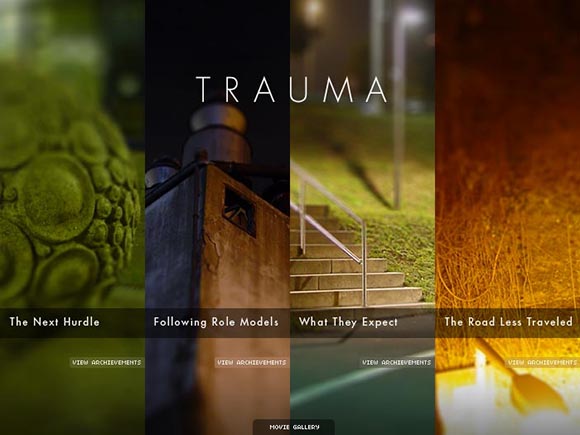
TRAUMA’s main menu was conceived quite a long time ago. I really wanted to use the photos already at this point. They should become the key aesthetic of the game. I tried different versions and realized that the photos work best when enlarged as much as possible. So the ended up simply dividing the entire screen in 4 photo stripes so the entire menu is made up of photos. It nailed my intentions pretty much and I noticed that users reacted quite positively to that solution

TRAUMA Old Main Menu

This was the menu screen for most of the development. The Movie Gallery tab at the bottom would slide up and reveal a menu of cut-scenes.

That worked well but with time, more requirements crept in. I needed to somehow display the progress in the four levels. I was able to implement that quite nicely with an Apple-like flip animation of the stripes. But then I also needed to provide a way to re-watch important cut-scenes. I added a small Movie Gallery menu at the bottom. That wasn’t quite as elegant anymore.

Recently I realized I also need some way to control the visibility and language of subtitles, reset the save game data and display some general game credits. The existing layout wouldn’t be able to take in these functions anymore. So I decided I would need a modal interface where additional controls would appear ON TOP of the main menu. It would give me the space I need to implement these functions as well as possible.

TRAUMA New Main Menu

This is a mock-up of the next step. The gallery is now a button leading to a separate screen. I also introduced a game options button. Also note the new volume slider at the bottom.

But with UI, things are never that simple. I start out creating a few mock-ups in Photoshop. While doing the mock-ups I often realize that some things may not work or require more space than anticipated. I sometimes even remember some functions I forgot, etc. Building the interface in Photoshop is often even quite tedious since you have to keep track of a lot of elements with lots of details. It sometimes seems like simply programming them would be easier. But the mock-ups are excellent at making you realize how deep the rabbit hole really is. Otherwise you might abandon the right solution in favor of an easy one.

TRAUMA Game Options

The game option screens allows to configure the subtitles, clear the save data and show credits.

And surprisingly, programming the UI is also quite difficult. Again, there are a lot of objects that need to cooperate with each other. It gets especially complicated if you want to include animations. Buttons need to have mouse-over effects, screens don’t just disappear but transition into each other. Those effects aren’t just fluff. They can make the navigation trough menus better understandable and less jarring. But the effects do increase complexity a lot. Programming them takes a lot of time and is prone to create bugs.

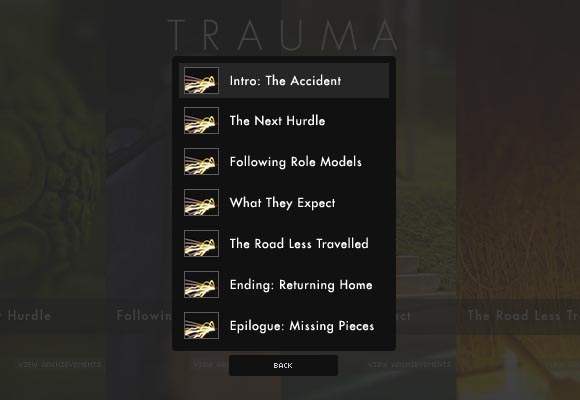
TRAUMA New Gallery

Putting the movie gallery into a separate screen allowed me to add thumbnail images and longer descriptions.

But I’m getting there. I’m quite satisfied with the mock-ups and I already implemented the first few buttons. There are still some details I’m not so sure about but I confident I will be able to figure them out as I go. I should be able to finish that big milestone this weekend. I will let you know how that worked out. If you have any suggestions, fire away. I can do changes easily at this point.

Backlog Be Gone

This has gone too far. I have already written about my Backlog problems. By not being able to resist the Transformers game recently, I realized that I can’t continue like this anymore.

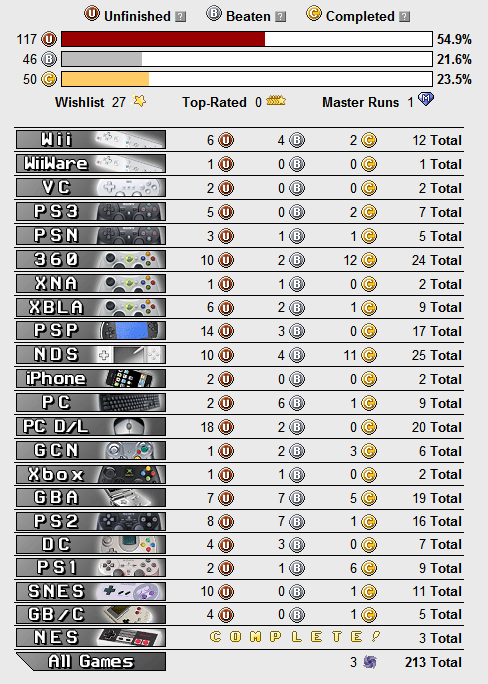
So yesterday evening I started to use Backloggery.com to make an inventory of my backlog. One thing lead to another and I ended up also making an inventory of most of the games I own. The results are worrying. I have 213 games. I haven’t beat 117 of them.

Backlog

Behold! My epic backlog of epicness. Click here to browse it.

As you can see, I have included some of the games I have already finished, but certainly not all. I didn’t include quite a few games that can’t be really beaten (Tetris) or where I don’t really have an intention to beat them (Metropolis Street Racer). And of course, I’m pretty sure I have missed a lot of games.

I knew it was bad but this is REALLY bad. I have to do what we all need to do in some form: buy less new things and enjoy more the stuff I already have. I decided to set some rules to reduce this backlog. I will only allow myself to buy a new game if I am able to remove at least 5 games from this backlog in return.

I’m curious if this will work. I already see a few small loopholes in there, I curious if they will become a problem. Should I find myself exploiting them, I will set up more rules. In any case, I will track my progress here. Wish me strenght.

I Want You to Believe

In the opening of the movie “The Fourth Kind”, actress Milla Jovovich claims:

Every dramatized scene in this movie is supported by either archived audio, video or as it was related by Dr. Tyler during extensive interviews with the director. In the end, what you believe is yours to decide.

It’s a two-fold lie. First, the original documents the movie is based on are an outright fabrication, including Dr. Tyler herself. Secondly, the movie never leaves any room to make any decisions. It’s almost like the hilarious joke by RedLetterMedia:

I let you decide… but the answer is yes.

I’m struggling which of the two lies is a more obvious mark of a bad movie.

Suggesting that a fantasy movie story is based on facts is a common technique. It actually produced some quite memorable works such as The X-Files or The Blair Witch Project. It enriches even a modest plot with a sense of excitement. It can greatly increase the tension and fear in a mystery movie.

But there are two crucial differences about The Fourth Kind. First, the Fourth Kind is an extremely boring story. It’s not even a story at all. It’s just two hours of dull repetition. One witness after another pops up telling how horrible the abductions are without even explaining what happened. They tried to add some story to it by including some silly mysteries about the Sumerian language and whatnot. All of this leads nowhere. What you already know about the alien abduction myth is probably far more exciting than what the movie has to offer. Hence, the “this is based on facts”-trick is THE ONLY EXCITING THING about this movie. The Blair Witch Project was at least original.

Secondly, the movie makes some extremely bold claims about the factuality of the portrayed events. They repeat it over and over again. There is even no fine-print disclaimer in the credits. It’s outright insulting to make so much a fuzz about what is a flat out lie. It’s also quite unreasonable to hinge so much on a claim that can be falsified so easily. It’s not only a scam, it’s a stupid scam.

But the movie tries to make a fool of the audience in a different way as well. The movie suggests that it merely represents the facts and that it allows the audience to make up their own mind. You wish! That would maybe even save the movie a little bit. But it’s far from it. From the get go, there all evidence is ALWAYS pointing directly to alien abduction. There is one skeptical character who is supposed to be the devil’s advocate. It’s a ruse, of course. The skeptical character never attempts to seriously debunk any of the conclusions. Instead he blurts outs some ridiculous, completely unrelated lines about weather balloons even if the evidence is right in front of his face.

A good skeptical character would act logically and attempt to respond to any shown evidence. For example, if there is evidence that somebody repeatedly enters a house at night, the reasonable thing to do is to call the police or at least set up some surveillance equipment. What the characters do instead is to rely on hypnosis. This is what really gets on my nerves.

Hollywood is responsible for the spread of some dangerous myths. One of them is that hypnosis is a reliable tool for psychotherapy. It’s not. Hypnosis is poorly understood, highly controversial and not used frequently at all. It’s not a scientific tool at all because it is highly susceptible to manipulation and suggestion. In fact, the very nature of hypnosis is suggestion.

It is almost certain that the entire myth of alien abduction was fabricated during hypnosis sessions. It is a powerful myth because it taps into very basic fears of supernatural nocturnal predators (monsters in the closet), being helpless and medical examinations. No wonder the meme spread so well. So it is quite ironic that The Fourth Kind relies almost exclusively on Hypnosis as evidence.

But even with an ensemble of idiotic characters, the movie could have created at least some room for interpretation. The police always suspects that the main character herself is responsible for everything. Her motif would be a psychological trauma caused by the death of her husband. It seems like a reasonable explanation at some point and it would be a great way to open up the plot for interpretation. Sadly, the movie does a great job at providing enough evidence to discard that branch of though entirely. The police ends up being just the ignorant bad guys and the movie goes down the drain.

And I haven’t even begun how bad the acting and the special effects are. The Fourth Kind is a rare occasion of a thoroughly ill-conceived movie. It looks down on it’s audience as being gullible, stupid and incompetent. It tries to succeed by exploiting these faults. This is not only morally reprehensible but also extremely reckless. If such an approach fails – as it does in The Fourth Kind – the underlying prejudices are exposed and the movie’s reputation is destroyed beyond repair. This reminds me of a TED talk I can’t find anymore. Somebody mentioned a great quote I can only party reproduce here: the best way to lie to somebody is when the other guy understands that you are being dishonest.

Monster Hunter Tri Diary 10 – Post-Game Content

I finally beat the game in single-player mode. The final boss is quite fitting. It is not difficult by any means but the fight is lengthy and feels especially grand. It also takes place completely underwater to underscore once more Monster Hunter Tri’s swimming mechanic. While the final boss doesn’t receive nearly as much foreshadowing as the Lagiacrus, I think it is still a fitting and a memorable fight nonetheless. I was especially impressed by the music that plays during the battle. It has the same Japanese chorus as the opening theme from Ghost in the Shell. A very stylish, unique and epic theme:

So now the game is over, I won’t bother you with it anymore and move on to other games? Not quite. I still want to dive a little bit into Multi-player mode. Especially now that Yu-Chung also got the game (and the Time).

But in the meantime, the game was also malicious enough to leave a nice little present for the ambitious player that I am: post-game content. After the last mission, 7 additional missions appear. They are not tied to any story so there is less pressure to take them on. They are all tough challenges for the dedicated players. 6 of the missions involve hunting two monsters in the same quest. This mission type is surprisingly challenging. First, fighting two monsters at the same time is impossible. So you need to use various items to attract and repel monsters so you fight them separately. Then, if the monsters are of a different type it can be difficult to chose the right equipment. For example, in one mission I need to fight the Lagiacrus and the Rathalos at the same time. For the Lagiacrus I would normally take a lance and thunder-resistant armor. But for the Rathalos, I need a Great-sword and fire-resistant armor. And finally, this is the first time where the time REALLY becomes an issue. The monsters in Monster Hunter Tri can take a lot of time to slay. The 50 minute quest limit is really putting a lot of pressure on you.

The 7th mission is about fighting the final boss once more but he is a bit more challenging this time. I will save that for the end. So far I’m trying to get though the other 6 missions and they are a tough cookie. Monster Hunter Tri really has a way to bring out the gamer rage in me like I was a teenager again. The mission where I needed to slay two Diablos at once left a visible dent in my IKEA gaming chair. Luckily I regained my professional emerged victorious in the end.

Let’s see how long I will be able to keep this up. I have spent a lot of time with the game and it’s starting to get stale for me. There are so many nice games out there waiting. Maybe it’s time to move on soon…

Repo Men & Pandorium

With temperatures reaching unbearable levels I decided to take it slow this Saturday and catch up with some movies. Sci-Fi movies that is.

First I watched Repo Men. The movie caught my attention when I came out in cinemas. It is built around a quite gruesome but catchy premise. In the near future an evil company sells expensive artificial organs on the basis of loan contracts. When the receivers of said organs are unable to pay, the company sends in assassins who remove the organs killing the receivers in the process.

Sadly, the premise falls apart under careful scrutiny. It is difficult to imagine a legal system that would allow this kind of business practice. But on the other hand, it doesn’t sound like a reasonable business model either. Killing your debtors doesn’t help anybody. On the contrary. Prolonging the loan under more severe conditions would pay off in the long term. This is how loans usually work.

The movie also fails in the department of action and characterizations. The action scenes are confusing and uninspired. The character’s motifs are sketchy at best. Starting with description the Schrödinger’s Cat experiment, I hoped the story would explore some of the philosophical questions of organ transplantation. A similar scenario was subject of the famous short-story “Do you exist Mr Jones?” by Stanislaw Lem (the full German text is here, I recommend). But sadly, no such ambitions.

As a redeeming quality there is a nice plot twist at the end. Nothing too revolutionary but just enough to keep the whole thing from feeling like a complete waste of time. All in all, a very average movie.

The second movie I saw was Pandorium. It was directed by the German director Christian Alvart. It takes place on a spaceship on it’s way to colonize a second earth. Crew members wake up from cryogenic sleep and realize that something went very wrong. It’s the tired formula of ugly space monsters chasing after frightened survivors in a dark, claustrophobic ship. Sadly, I’m a sucker for Sci-Fi so they had me at “spaceship”.

I was expecting the worst and I was pleasantly surprised. Yes it is very clichéd. The monsters are silly and have no real reason. All characters seem to struggle with amnesia and other psychological problems. But in the end, all those well-known clichés are well executed and come together to create a solid mystery. The reveal at the end is well done and surprised me even a bit. The characters have some depth to them. The set design is excellent, especially if you compare it to the poor set design of Start Trek.

It may not me a masterpiece but it is a solid, entertaining watch. If you like Sci-Fi, I do recommend it.

Videogames in other Media Ep. 4: The O.C.

The TV Series The O.C. had an interesting take on Video-games and gamer culture generally. One of the most memorable characters from the show was Seth – a gamer and comic nerd from a rich family. He was also responsible for the comic relief in the series. Personally, I really liked the character. I think they did a great job at creating an extremely likable yet believable nerd character. You would laugh with the character not at him, quite rare for the portrayal of gamers.

In the series various characters were frequently playing Video-games. First it was mainly Seth with his friends, later on even the adults joined in. Gaming was shown as a very social thing to do.

Gaming plays an important role even in the pilot episode. The protagonist Ryan comes from a poor family and gets arrested for stealing a car. His attorney wants to help him out and invites him to live with his family in a rich neighborhood. This becomes a constant source of conflict throughout the show. In the pilot, there is a scene when Ryan first meets Seth, the attourney’s son. It goes like this:

I’m afraid the video is in French. You can see the english version here. Fast forward to 1:55. Here is what Seth (the gamer) says at the end:

Oh, hey, do you want to play Grand Theft Auto? It’s pretty cool. You can, like, steal cars and…not that that’s cool…or uncool. I don’t know. Um..

The acting is passable. Ryan is not using the controller properly but he shouldn’t be a gamer anyway so I’d let that one slide. Seth’s acting is a bit more troublesome because he is looking at the buttons and he is supposed to be an experienced gamer. The trash talk is borderline. It seems a bit over the top, even for Seth.

But the general idea if the scene is quite good. Ryan is a stranger to this environment. It’s awkward when he first meets Seth. The video-game is a great plot device to break that first ice and establish a common ground for both characters to learn about each other. Seth is immediately characterized as a talkative gaming enthusiast.

Of course the reason I mention this is the final joke. Even though it looks like the both characters bonded with each other, mentioning the game GTA and how it portrays stealing cars as entertainment re-established that both come from very different backgrounds. The initial awkwardness returns. This is exactly the kind of writing that is possible when the writers know something about games. It perfectly underscores the differences between the characters. It also can be seen as a social commentary – the criminal’s life is the spoiled rich kid’s entertainment. But in the end, it’s just also simply funny.

I liked the seres a lot. It was one of the “girly” series I watched with my Girlfriend a lot. Unfortunately, the quality dropped rapidly after the first season. But I look back fondly on the first season and especially the first few episodes, not only because of how it managed to avoid typical video-game stereotypes.

License Games Done Right

Two games make a trend, right? If so, I really enjoy the recent trend of making license-based games demonstrated by Batman: Arkham Asylum and new Transformers: War for Cybertron.

What both games did is they completely ignored any opportunities to do any movie tie-ins. The games releases were not synchronized with any movies from the same franchise. The stories are completely unrelated. Even visually, both games completely ignored any templates set by their movie counter-parts. I presume this allowed the developers to spend as much time as they needed to adapt the franchise to the specifics of the games medium.

As a result, Batman: Arkham Asylum became one of the most memorable Batman games yet and certainly one of the moist acclaimed games of 2009. I haven’t played Transformers beyond the multi-player demo yet. But I enjoyed from what I’ve seen so far.

Full disclosure: Transformers are one of my favorite series I grew up with as a child. Even though the shallowness of the story and the characters are utterly unbearable for me today, I can’t deny my emotional attachment to them. This soul-tearing mixture of visceral fascination and sheer embarrassment is what I see faithfully reproduced in this game. In this regard it is the most attractive Transformers game I’ve seen so far. Plus, everything that reverts the damage done by Michael Bay is good in my book.

(And secretly I still hope for a Christopher Nolan or Neill Blomkamp to come in and make a Transformers movie I’m not embarrassed to watch).

But generally speaking, I really hope this mode of dealing with license games will catch on. I think in can do a great job at allowing games to emancipate themselves as a medium on the own.

Hold to Skip

It’s Wednesday. This means I should have been working on TRAUMA. Fortunately I did!

I finished the the volume slider integration and went on working on yet another small feature: skipping cut-scenes. Cut-scenes are a rather controversial part of games today. Many consider cut-scenes as sign of failure to integrate gameplay and story. I do understand the concerns. However I wouldn’t go that far. I think it is a valid tool for communication as long it is not over-used. As always I think it is a matter of measure.

Let us look into other media as comparison. Movies are a visual medium. The admonition “Show, don’t tell” summarizes quite nicely how to generally communicate in movies. Following this admonition, voice-overs, lengthy monologues and – god forbid – plain text shouldn’t be even considered by movie makers. Yet those techniques are sometimes successfully used in the most iconic movies such as Star Wars (opening crawl), Fight Club (voice-overs) Blade Runner (voice-overs and monologues) and many more. They are tools and it really depends on how you use the them.

I use cut-scenes in TRAUMA. I don’t know if I over-use them but they are an integral part of the concept. I am aware that I need to be careful with them so I want to make them work as good as I can. If there is one thing that game developers often get wrong when using cut-scenes is that they can’t be skipped.

Games are often played repeatedly and it is inevitable that at some point players will come across the same cut-scene twice. In such cases an otherwise pleasurable experience can turn sour. It can be quite annoying having to sit trough a cut-scene you don want to watch. It’s true that you can’t skip a movie in a cinema but in this case, sitting and watching is the whole point. Also, DVDs allow skipping individual scenes just fine.

But of course there is always the flip-side. As a game developer you invested a lot of time in cut-scenes. You’ve written a story, you invested considerable resources to produce the cut-scene. You don’t want you baby to be disposable too easily. So at the very least, you want to make sure that users won’t skip the cut-scene by accident. If a player skips a cut-scene by accident he might need to jump through a whole bunch of hoops to undo their mistake.

It’s an interesting interface design problem. What do you do? You can make the skipping button hard to find but that increases the chance that users won’t find it even if they do want to skip. This means you have to add a note that reminds users which button to press, but that simply looks awkward. You can add a dialogue box asking users if they REALLY want to skip but dialogue boxes are inefficient, annoying and don’t work anyway..

A solution I don’t see implemented too often is the following one: EVERY keyboard or mouse button can be used to skip a cut-scene. However, you need to hold that button for at least a second. When a user doesn’t press a button long enough, a note appears in the corner to explain. This ensures that users will be able to skip the cut-scene if they want to. This also ensures that users won’t skip the cut-scene if they click accidentally.

Hold Button to Skip

Every button can be used to skip a cut-scene. You need to hold it for a second. A note in the upper right corner appears if you don’t press long enough.

I implemented this solution today and it works well. I even went the extra mile. Not only the closing and opening cut-scenes skip-able, but EVERY longer animation in the game is.

I don’t think it is perfect solution but it’s the best I could think of in this situation. How do you find that system? Have you seen better cut-scene skipping systems in other games? Did you have some particularly bad experiences?

P.S.: I recommend LoadingReadyRun’s Unskipable for a humorous take on the subject.

About

The Game Design Scrapbook is a second blog of group of three game designers from Germany. On our first blog, Game Design Reviews we describe some games we played and point out various interesting details. Unfortunately, we found out that we also need some place to collect quick and dirty ideas that pop into our minds. Hence, welcome to Game Design Scrapbook. You will encounter wild, random rantings. Many of then incoherent. Some of them maybe even in German. If you don't like it, you might enjoy Game Design Reviews more.

Twitter

follow Krystian on Twitter
follow Yu-Chung on Twitter
follow Daniel on Twitter