Polishing TRAUMA

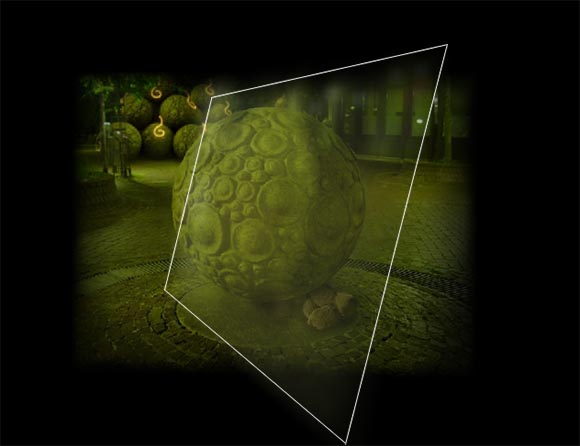
TRAUMA is at a point where I’m wading trough a bunch of very small tweaks and additions. It’s pretty much pure polish at this point. So for example there is this specific place in one level where the navigation causes some problems. It’s a sphere and I have constructed the level in such a way that the player is able to walk around the sphere. In fact, this was the oldest piece of level architecture that made it to the final product. Because I was inexperienced when I have built this, it’s doesn’t work quite right. The individual photos are placed in such a way that the players sometimes need to click on the left side of the screen to go right. It’s consistent and logical but very confusing and unintuitive. During play-tests I watched many players struggle at this point. The problem is severely enhanced because this is the place the entire game starts when players chose to go to level 1 first. It leaves a very bad first impression to say the least
TRAUMA Navigation Tweak

You need to click on the right portion of the screen to make the camera go left. Not exactly intuitive. (white box is just for reference)

So I have implemented a hard-coded fix just for this location. Just in this place, the navigation is controlled by the overall position on the mouse on the screen rather than the real mouse-over on the individual photos. I really hope this will solve the problems people had with the game. After all I was used to the “old” way, but the tweak feels more intuitive even for me.

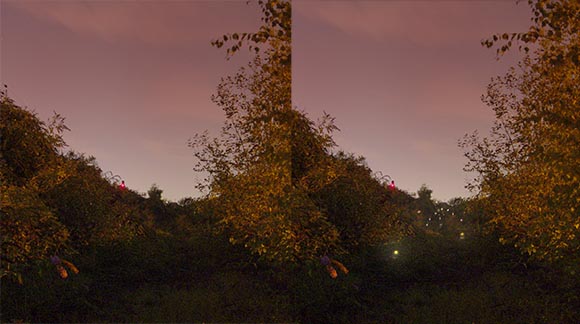
Another tweak is more visual. I noticed that players were struggling to find an important place in one level. Watching them play I have identified a specific screen where they would stray off the correct path. I think it’s because the photo didn’t look like there was something interesting in that direction. I have decided to add some visual hints to lure the players in.
TRAUMA Guide Tweak

Players wouldn’t consider going along the dark path. Added visual clues to remedy this. On the other hand, finding path in the dark is the point of the level. At what point am I undermining my own intentions?

It is a very subtle tweak and I’m a bit torn on this one. Streamlining the level too much could undermine the intention. On the other hand, getting stuck is worse than some mild ludo-narrative dissonance.

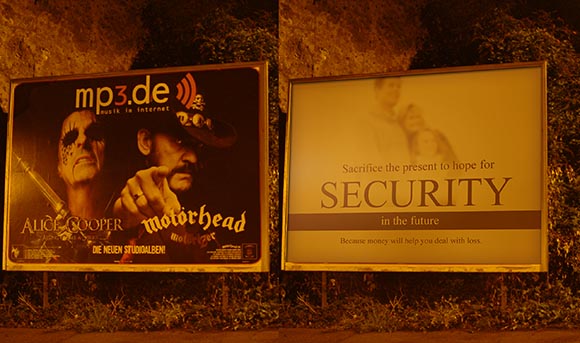
A third example is purely aesthetic. Some of the levels included elements that didn’t quite fit into the narrative. Sometimes you can see too much of the buildings surrounding the locations. At one point there are even billboards with real commercials. So I am photoshopping some of the unwanted structures.
TRAUMA Billboard Tweak

To underscore the indie-ness of the game, I have the urge to remove all ads from the photos… also I don’t want to be sued… and also it makes no have ads for German mp3 websites in your dreams. Oh wait, did I just miss a monetizing opportunity?!

I use this opportunity to add some more narrative elements. For example, I replace the billboards with fake ads that add some more substance to the theme of the level.

I’m trying to increase the amount of work I do. At this point there is not much left so I can afford to crunch for a while. Of course now is exactly when I’m needed at my job because of the upcoming GamesCom. Now where did I put that cloning device..-
Story in StarCaft 2

I guess there are Spoilers coming up but seriously, don’t bother. Having finished the campaign of StarCraft 2, I can now safely say that the game features a very disappointing story. The characters are incredibly clichéd and poorly fleshed-out. Some of the writing is amazingly dull and hollow. Here is a taste I recently found on the forums:

Good Guy: “Its aint over yet you son-of-a-bitch!” (fires a gun at a TV screen showing an interview of the bad guy)

Matt: “I don’t trust that guy…” (about Tychus)

Tychus: “I don’t trust that guy…” (about the Specter guy)

Good Guy: “At some point we have to choose who we are.”

“You can’t fight fate!” “Why do you run from your fate?” “It is the fate of the world…”

There is barely any conflict between the characters. Somehow everybody wants roughly the same thing (kill the Zerg, kill the evil dudes). If there is a conflict after all, it’s contrived and artificial. They suddenly pull out another character out of nowhere (Nova says hi) who just happens to present a neat 2-choice dilemma on a golden platter. Or suddenly the crew is against you. And then there is a bar fight, you do an inspirational speech and suddenly everything is back OK again. Wait! What was that bar fight for again? The entire plot is solved by a blatant Deus-Ex-Machina – “that mysterious thing you were doing the whole time for money? Yeah, that will magically undo all the things that tormented your protagonist all the time”. Isn’t the point of a tormenting past the fact that you can’t change it? Doesn’t character growth mean to deal with this past?

A good indicator is the humor. The game frequently features TV broadcasts with two reporters. It’s supposed to show in an ironic fashion how the corrupt government is controlling the media. The female reporter tries to present a truthful view of the situation in which the rebels (you) tend save the day. The other reporter cuts her off or re-interprets the events so that the rebels appear as the bad guys. It comes off as incredibly ham-fisted and gets old after the second sequence… but there are more than 10 of these.

StarCraft had much less story than StarCraft II but StarCraft: Broodwar, the expansion achieved the same effect through a cheesy Starship Troopers-style propaganda report. It was much more subtle and amusing.

Of course it’s not all that bad. There are some promising attempts. I liked some of the scenes between the protagonist and a female researcher. Sadly it never goes anywhere. I also laughed out loud at a couple of well-placed self-referential blurbs in some of the dialogue during missions: “No rush” or “Terrible, terrible damage”. But all in all, it’s rather forgetable.

But wait, I did praise the story part some time ago, didn’t I? Yes, and I still stand by it. The structure in which the story is presented is a welcome innovation with a lot of potential. It just wasn’t used by Blizzard to do anything good.

But then the first game didn’t have exceptional story either. Actually, no Blizzard game was ever known for exceptional good writing. What makes StarCraft 2 still an extremely compelling game is the polished game-play, comprehensive multi-player structure and especially the varied, well thought-out single-player missions. On the other hand – good writing wouldn’t sabotage any of these. And this time Blizzard can’t really excuse themselves by a lack of resources or time. Let’s see if they will be able to turns things around with the next two installments. Until then, I’ll just skip the cut-scenes.

Itokawa in Paris

The perception of size is a fascinating topic. Humans seem to have a very well developed sense to comprehend the size of objects intuitively. However, that mechanism is heavily skewed towards objects that are roughly the size of humans themselves. We seem to intuitively be able to grasp very fine nuances in the physical dimensions of objects that we can observe in everyday life and grasp with our hands. As soon as we deal with objects that are much bigger (cities, mountains, planets) or much smaller (microbes, molecules, particles) our instinctive feel for size stops working properly. So we can grasp the fine nuance of the difference between a football and a basketball. But we seem no have no problem of putting the Mercury in the same category as Earth. The recent discussions on the status of Pluto are symptoms of our inability to mentally access those objects

Of course when speaking of large or small (or simply yet unseen) objects, we still can use numbers to get an idea of the size of those objects. Our minds are capable to get us where our instincts aren’t able to follow. So scientists who deal with those objects on a daily basis can develop a sense for their dimensions. Still, I believe there is an inherent difference between this mental crutch and a genuine feel.

But there is a different way. Designers, who work visually know very well how to exploit this human sense for dimensions to communicate ideas more effectively. For example, Concept Artists have learned to always include human figures in their drawings. Those figures aren’t characters. Their purpose is to help the viewer to calibrate the scale of the image – something that is especially important in rough, sketchy scribbles.

Concept Art

The purpose of human figures in concept art is to communicate the proper scale of the image.

Similarly, good Information Designers always put their data into context of other data. Data only becomes information when in context of other information, already familiar to the audience. Raw data is shallow and meaningless. Applied to visual information, you arrive at quite the same result – to put familiar objects next to unfamiliar objects as a reference.

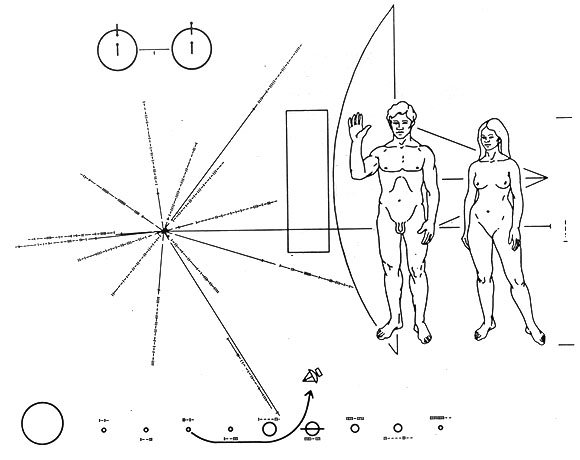
Pioneer Plate

A funny reversal of the rule. The plate on the Pioneer Probes shows two humans in front of a simplified schematic of the probe itself. This time, the reference works the other way around. An audience unfamiliar with human beings should be able to get an idea of their size using the space probe as reference.

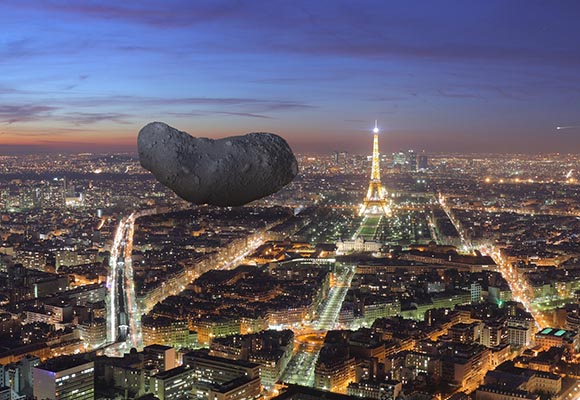
So you might remember my last post about the asteroid Lutetia. Images of the asteroid itself didn’t communicate properly how frigging huge this asteroid was. Putting it next to the Moon and other asteroids helped a little bit. It created a context for the image and established a hierarchy among those objects. But that hierarchy was still a stand-alone-complex. It didn’t really communicate the size in human terms. So here is a different attempt I experimented with recently. It shows the asteroid Itokawa. It’s a tiny asteroid that was recently visited by the Japanese space probe Hayabusa. I photoshopped the asteroid onto an image of Paris. Using the Eiffel Tower as a reference, I was able to calibrate the size so it’s roughly to scale.

Itokawa In Paris

Itokawa in Paris. Click here for huge size.

I used the official Hayabusa images and this breathtaking Photo, which actually is my Wallpaper at the moment.

You should note that there is a lot of stuff scientifically wrong with this picture. First, I did some subtle manipulations to the image of Itokawa, removing some of the harsh shadows. Actually, the real asteroid may even have a slightly different shape. The brightness and the hue of the Asteroid is a complete guess. Official numbers say it has an Albedo of 0.53, around as bright as new concrete.

More importantly, that image could never happen. Even if the asteroid actually fell on Paris, it would never reach the ground in one piece like this. Like the majority of asteroids, Itokawa is actually a so-called “rubble pile”. It is not once piece of solid rock like we often imagine asteroids. Instead, it’s a very loose clump of smaller rocks and dust. Even the smallest disturbance such as tidal forces or the atmosphere would probably blow the asteroid into pieces. I guess some of the pieces would reach the ground… but it would look very different.

Still, I find it quite useful to get an idea of the size of that thing. Keep in mind that this is a tiny asteroid. Check out the recent size comparison chart of Asteroids. Itokawa is just a pixel or two on that image. I might do a few other asteroids at some point for fun. Until then, enjoy!

Monster Hunter Podcast Episode 3

monster hunter podcast

There is a new Episode of the Monster Hunter Podcast up. This time it’s about Urgent Quests. We finally get to discuss individual monsters. We do a run-down of general strategies for 3 Urgent Quest monsters – the Barroth, the Lagiacrus and the Jhen.

Get the Episode here.
The RSS Feed is here.
Get us in iTunes here.

The Tumblr Blog here.

Enjoy!

Bonus CGL Poster

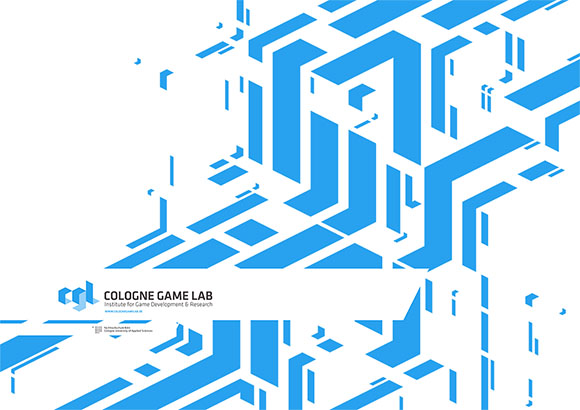
Currently a bit swamped. TRAUMA update coming up. Until then, here is a poster I made a year ago or so. I recently dug it up and realized that I haven’t posted it before.

I did this to promote the start of Cologne Game Lab at GamesCom 2009. The Cologne Game Lab is the institute I’m currently working on. We are about to start a master course in Game Development and Research. There is still some time left to apply, if you are interested.

Speaking of GamesCom, we will have a small booth at this year’s GamesCom. If you are interested in Cologne Game Lab or simply want to get in touch with me personally, just drop by! I’m looking forward to it.

Get Get Lamp

Just a quick post today. The Internet multi-celebrity researcher Jason Scott recently finished the work on his newest documentary Get Lamp. Here is a trailer.

The documentary is about text adventures. It features an excellent selection of interviewees. I already noticed that there are not too much people dedicated to preserve material and resources on that particular niche genre. So that little documentary is certainly a precious gem. You can order it here. It costs around 50$ – not exactly a bargain bin deal. On the other hand, it’s an indie documentary about a very niche subject and it come with lots of bonus material and lovely special edition swag. I didn’t have to think twice.

Zergling Rush

The Zergling Rush is probably one of the most recognizable gambits in the gaming culture. Even players, who never played StarCraft often have a rudimentary idea what it is is referring to. In fact, the term is so well-know that it seems to have undergone a slight semantic shift. People often mistake it with attacking the other player with a overwhelmingly large quantity of small units. The name is often abbreviated to a misleading “Zerg Rush”. I presume the reason is that most people never actually executed a real, honest Zergling Rush.

But with StarCraft II out many players – me included – can dip back in the world of StarCraft to re-visit some of it’s classic tropes. I must admit even though I was the victim of numerous Zergling Rushes, I have never played the Zerg race for long enough to try this particular strategy by myself. Thankfully the well-structured multi-player system in StarCraft II encourages players to experiment a lot more. Inspired by some of the challenges, I just recently gave it a coupe of shots. It’s an experience I strongly recommend.

So here is a recipe for a classic “6-Pool Zergling Rush”. Contrary to what many people think, the idea is not to build a ton of small units. Instead, you need to execute an extremely time-sensitive build sequence to get offensive units as fast as humanly possible and use them to cripple the enemy before they can do anything about it.

  • 1. Don’t build a drone. As the game begins you have 50 minerals to build your first drone. Don’t! Instead, send all your other drones to collect minerals and wait until you get 200 minerals. In fact, if everything goes well, you will finish the game with just 5 drones. They will be enough to produce the small quantities of units you need.
     
  • 2. Build a Spawning Pool. As soon as you have 200 minerals, quickly select one of the drones and build a Spawning Pool. This building is everything you require to produce Zerglings. If things go well, you won’t be building any other building in this game.
     
  • 3. Produce an Overlord. The Spawning Pool takes some time to build. Meanwhile your mineral count should hit 100. Use this opportunity to build an Overlord. It will allow you to keep producing more Zerglings as reinforcements to the initial 6.
     
  • 4. Produce 6 Zerglings. By the time the Spawning Pool gets finished, your mineral count should be back around 150 minerals. This is it. Produce 6 Zerglings as soon as you can. You should have 3 larvae. Each larva will mutate into 2 Zerglings. Set the rally point at the enemy base so the Zerglings will start running there as soon as they hatch.
     
  • 5. Keep pumping Zerglings. As your Zerglings make their way to the enemy base, keep producing even more Zerglings. Turn every new larva into Zerglings. Because of the rally point, they will join the first 6 as soon as they hatch. It’s a good idea to put your hatchery on a control group. (Select it and press Ctrl + 1. No matter where you are, you can then always produce more Zerglings by simply pressing 1, S, Z. Keep doing this throughout the next step).
     
  • 6. Cripple the Enemy. Now comes the tricky part. You have only 6 Zerglings and you need to do as much damage as possible as you can. Ideally you enemy shouldn’t be able to recover. It all depends on how fast they are. The computer AI is fairly quick and mostly has already a first production building up. Concentrate on destroying all producing facilities. Alternatively, you could also try to kill their economy units. This part is really hectic and requires quite some micro-management skill. If your Zerglings encounter resistance, you need to properly judge if they are in danger and maneuver them in a position where they are at an advantage. Luckily, there should be more Zerglings steadily pouring in. So you can always retreat for a second to meet up with the next group of reinforcements.

Here is a video tutorial to see how this looks like in practice. Note that the recipe is a little bit different in this video. Also, it’s a video that actually shows a failed Zergling Rush. The enemy is able to defend themselves.

After executing it for a couple of times, I really stared appreciating the different nuances of this strategy. First of all, it’s incredibly risky. You go all out. By the time you reach you enemy, they will have an economy way ahead of you. If they manage to stop your Zerglings, you will be caught with you pants down. They will be able to produce units much more quickly than you do. Your chances are will be slim. On the other hand, if you succeed, you win the entire game in just 5 minutes with minimal effort.

And of course, it’s incredibly frustrating. In the early days, Zerg players used to rush and quit if they failed. It was rare to have a proper game against a Zerg player. Nowadays, things are more balanced and it’s not such a popular strategy anymore.

But finally, there is something beautiful about it as well. The way the timing works out. The way all the mechanics click into place to give you just enough resources for this one attack. Even with such a tight schedule there is still some room to mix things up. For example, in the video above, the player builds two drones instead of the Overlord. He builds the Overlord after the 6 Zerglings hatch. This slows down the initial reinforcements but leaves him in a slightly better position when the rush eventually fails.

Of course I don’t suggest trying this on real players. However, it’s fun to use it on the AI. Even on “Insane” difficulty, the AI can be easily defeated in under 5 minutes. And the game actually encourages to try it out by giving out achievements for doing so.

The Zergling Rush turned from a degenerative strategy to a well-know and almost over-used meme. The challenges and achievements in StarCraft II acknowledge the Zergling Rush as a valid aspect of the game. Nowadays it almost comes with the class of a risky opening in a chess game. It’s fascinating to be able to watch this niche of gaming culture mature and create it’s own history. StarCraft II it’s the perfect opportunity to re-discover and experience this history on your own. Who knows how this part of culture will evolve further.

Guided Multi-Player

Initially, multi-player was without form, and void. People would randomly engage with each other in endless, monotonous Quake 3 matches. Then came Call of Duty 4. It introduced simple RPG elements into multi-player. Players would collect experience points, unlock achievements and upgrades. They would maintain a profile across matches. It provided a rudimentary structure to multi-player. Players saw that it was good. Designers started to blindly copy this approach, with not always the best results.

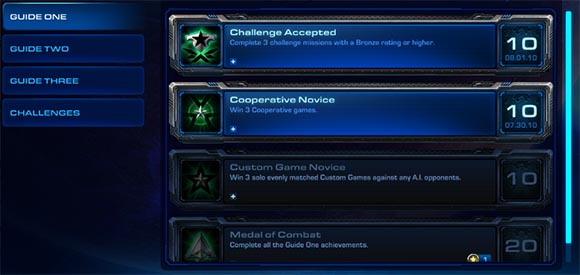
One of the reasons why I really enjoy Star Craft II is that it goes further. It creates a much more comprehensive structure to multi-player. It especially focuses on guiding new players into the multi-player community in ways it has not been done before. The game has a group of achievements called “Exploration”. They are specifically designed to teach players the necessary skills to compete on-line.

Star Craft 2 Guides

Exploration achievements guide players into the world of competitive Star Craft II.

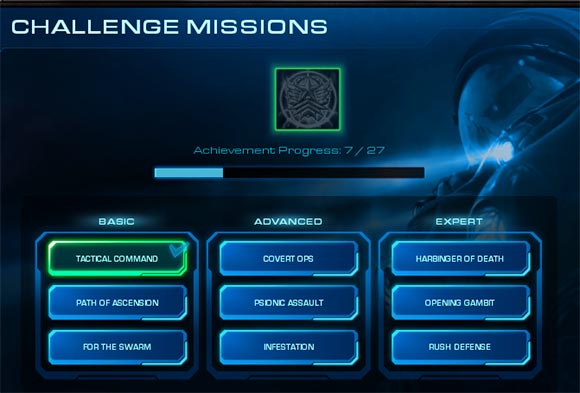
There are 3 levels of Exploration achievements. They start out with tasks like playing a certain number of games against the AI. They end up with tasks like playing and winning certain kinds of multi-player modes against other human opponents. But that’s not all. A key element of the Exploration achievements are the Challenge Missions.

The single-player mode a the multi-player mode drifted apart even further in Star Craft II. Single-player now includes units and upgrades that don’t exist in multi-player. Transferring skill from one mode to another is even more difficult. The Challenge Missions are here to fill the gap.

Star Craft 2 Challenge

Challenge Missions are single-player missions that teach multi-player skills.

They are single-player missions specifically designed to teach multi-player skills. For example, the early missions will make you defend yourself against waves of various type of units. You have a limited amount of certain units yourself. Your task is to split your army and perfectly match your units against the enemy. Think of it as tower defense but with units instead of towers. Other Challenge Missions teach you how to build up your economy or counter a rush.

It’s a very polished, user-friendly and fun way to ease players into the multi-player way of thinking. The challenges are perfectly balanced so that there is aways a key insight to solve the puzzle – something that might not happen in real multi-player. The game even provides you with hints in case you can’t figure it out yourself. And when you eventually make it, there is still plenty of things to learn by micro-managing your battles to maximize efficiency in order to score a better ranking.

But of course, not everything is quite perfect yet. The Exploration Achievements are hidden among a flood of various other achievements. It seems to me that it is very likely that new players will miss them altogether. The Challenge Missions also also a bit under-played and seem to be a little limited in scope.

More generally, the game provides a structure on how to get INTO multi-player but doesn’t provide a structure of how to get OUT of multi-player. There are no exit points that would provide closure for players, who don’t want to keep playing forever. Under this circumstances there are two possibilities – you either become an eSports pro gamer or you quit the multi-player out of boredom and frustration. Considering how the percentage of pro gamers is rather small, a vast majority might end up looking back on Star Craft II not quite favorably. I guess that innovation in multi-player structure is still to come.

Nevertheless, I’m still quite impressed by the improvements. I really do hope other games will copy this approach. I would love to see Challenge Missions for other types of games. I wonder what a Challenge Mission for a first-person shooter would look like.

Limbo

I know you probably already know about it is slow news day. The game Limbo came out recently.

I was able to play the game at this year’s IGF already. I haven’t bought it yet due to my backlog. But it is certainly an intriguing title. There are two things I like about it and one thing I’m not so sure about.

First, the I think visuals are really amazing. The black and white silhouettes are a bold stylistic move. But the game goes so much further. There are some very elaborate depth of field / vignette effects in play to create a breathtaking look. Additionally, the game features some of the most impressive dynamic animations I’ve seen for quite some time.

The second thing I really enjoy the gameplay. Games like Another World and Flashback belong to my favorites. It’s obvious that Limbo was inspired by them. The game is more about solving environmental puzzles than anything else. The puzzles often look very simple but turn out to be pleasantly challenging. And yes, you will die a lot.

Which brings me to my gripe. The game is excessively brutal. Your character is a little boy and the game puts him through a series of the most violent deaths. He is constantly being decapitated, impaled, crushed and eaten. The game seem to indulge in those moments by showing the death animations in excruciating detail. It feels very immature to me. Sure, I’ve seen a lot of violent deaths in games. But judging from the subdued look and feel I was expecting Limbo to be different. I was expecting it to focus on narrative value rather than such visceral effects. On the other hand, the brutality may have been an intentional tool to emphasize the vulnerability of the protagonist and the inhospitality of the environment the game takes place in. Still, I can’t shake the feeling that the game’s content doesn’t quite live up to it’s visual style.

In spite of this, I can totally see why the game was received so well at this year’s IGF. Especially the technical execution really is outstanding. If you haven’t played it yet, I recommend you try the demo on XBLA. Let me know what you think about the game’s brutality.

P.S.: Oh yeah and I find the Typography really horrible.

Canceling in TRAUMA

There one thing that always gets on my nerves: games often expose players to serious loading times without ever giving any means to cancel a loading sequence. This actually turns a lot of the choices in an interface into very unforgiving time wasters. It can a very frustrating to accidentally select the wrong level. You know you made a mistake but you are still being punished by a potentially long loading sequence before you can do anything about it. Of course those problems are even more serious in TRAUMA because most of the assets are loaded over the Internet. Depending on the Internet connection, a loading sequence might turn out to be quite lengthy. Spotty Internet connection might even cause the loading sequence to fail completely. So today I finally implemented a “cancel” button on the loading screen.

Cancel Load in TRAUMA

Such a small button, yet it can change so much.

Unfortunately, implementing such an inconspicuous feature turned out to be quite complicated. The command of loading a level initiates a huge cascade of processes. Canceling them means you need to literally stop a chain reaction in place. You need to get an idea how far the process went, sabotage further progress and finally undo and reset the system. Things are even more complicated by the fact that a lot of the file management stuff is very haphazardly coded right now. You see, when I am coding a game, my goal is to see results as quickly as possible. I want to see results so I can evaluate if what I’m working on is worth spending more time on at all. So when the game requires a file I often opt for the simplest solution possible. And of course this solution often lacks all the proper bells and whistles a polished consumer products needs to have – canceling, progress tracking, error handling. When finishing a game, I need to go through all the code and add all the missing features afterwards. Of course, by then I can’t remember where and how I did some shortcuts. Often, my quick solutions turn out to be amazingly inefficient and complicated in hindsight. I uncovered a large piece of those old shortcuts today when implementing the cancel button. I was able to fix some of them but there is still a more exhaustive code review pending. Until then, the cancel button is in place and works well.

One thing that I was reminded of today I how much I hate the way Flash handles the removal of objects. You see, you can create new objects just fine. But the way the language works, you can’t specify to DESTROY an object. What you instead need to do is to remove all traces and references of this object in other objects and then cross you fingers that a mysterious “Garbage Disposal” process will kill the object by itself. The Garbage Disposal is completely invisible. You will never know if it worked or not. It’s an amazingly coder-unfriendly way to design a programming language. It takes away control, it’s almost impossible to debug and it causes unintentional waste of resources. Canceling a loading process is exactly one of those situations where you WANT to explicitly kill a bunch of objects and you want to make sure they are REALLY gone. So to all Flash coders out there: if you know a good way to debug Flash Garbage Removal, please let me know.

About

The Game Design Scrapbook is a second blog of group of three game designers from Germany. On our first blog, Game Design Reviews we describe some games we played and point out various interesting details. Unfortunately, we found out that we also need some place to collect quick and dirty ideas that pop into our minds. Hence, welcome to Game Design Scrapbook. You will encounter wild, random rantings. Many of then incoherent. Some of them maybe even in German. If you don't like it, you might enjoy Game Design Reviews more.

Twitter

follow Krystian on Twitter
follow Yu-Chung on Twitter
follow Daniel on Twitter