Presentations

I’m back from FMX. It was great as always. I got some awesome feedback on Illucinated and saw some great presentations.

Which brings me to today’s topic: presentations. As a graduate of KISD this happens to be a topic I have a lot of experience with. The concept of KISD is that whenever you create something there, you have to present it in front of a large audience. You end up doing around 5 public presentations per semester. And this is important too because communication is one of the most important skills for a designer. Doing a good presentation requires a good understanding of the audience, information design and dramaturgy. So when I go to conferences like FMX, I always cringe at the n00b mistakes even most experienced movie/games industry pro make in their presentations. Here is a unsorted list of 8 things that people often do wrong.

  • No practice
    Practicing your presentation is pretty much the MOST FRIGGIN IMPORTANT THING YOU HAVE TO DO! And let me get one thing straight: going trough the presentation in your mind is NOT practice. You have to actually speak out those words loud. Do it a couple of times alone. Do it afterwards in front of a friend or family to get some feedback. Then do it over and over again until you get sick of it. And then do it even more. For a short presentation of around 15 minutes, you should aim for doing something like 20 practice runs. And also: don’t do them in a row – that only creates false security because you will talk yourself warm. Make at least 1-hour breaks in-between each practice round. Which means you will have to practice for at least two days.
    Practice is important because it allows your brain to explore the mental space of the things you can say to avoid mistakes during the presentation and boil the data down to the important information. It will also help with stagefright. (EDIT: And PLEASE take your time when you practice! A presentation running too long is bad for everybody involved.)
  • Reading
    Reading a pre-written speech is the best way to lull your audience into sleep. Written language tends to be too information-dense for a oral presentation. Also, when reading the person presenting tends to read too quickly and with bad intonation. Basically, reading aloud is NOT communication. If you are not trying to communicate with the audience, they won’t listen.
    Which doesn’t mean that writing down the text of your presentation can’t help. It’s a good starting point to get your ducks in a row. But when you get on stage, you need to be able to throw that note card away and speak freely.
  • Splitting the presentation among many people
    “And now Bob will tell you something about alphanumerical encoding in paralell processing – thanks Dick! I’m Bob and – uh – I will tell you something about alphanumerical encoding in paralell processing”. Presentation n00bs will often think that splitting a presentation among a few people has some advantages. It doesn’t. It’s a common fallacy. Long before a presentation is due it may seem scary. So it may seem like having to do only half a presentation would be only half as scary. But when you actually doing a presentation, it doesn’t matter if you are there for 7 minutes or for 15 minutes. It’s both equally scary. Most people talk themselves warm after a couple of minutes and are able to deal well with the situation. So splitting a presentation means that just when the presenting person has become comfortable in front of his audience, you cut him off and put up another horrified one who needs again a couple of minutes to get up to speed. Also, an audience gets used to the person speaking. Changing people means you have to get used to a different person. Often you will compare the second guy to the first guy and the second guy will always have the disadvantage of simply not being the first guy. It’s like when they changing the staff in a TV Series. Remember Sliders? Didn’t work so well. Finally, when the presentation is split, the moment of change between speakers needs to be practiced even more because it requires two people perfectly understanding what they are supposed to say. If you don’t, you just end up looking stiff and awkward. So splitting a presentation has a lot of disadvantages and no advantages. Better have everybody learn and practice the entire presentation and then pick the best one to speak on behalf of the rest.
  • Slides
    Speaking of Sliders. Using Powerpoint seems to be a common practice now – even in cases when it is redundant. Don’t succumb to that fallacy. Do you REALLY need slides? What do you REALLY need to show. Imagine each slide would cost 20 bucks. What would you show? If you do slides, for heaven’s sake don’t put up bullet points of the things you will say anyway! It’s silly! Proponents of slides will tell you that using slides means using two information channels. But that doesn’t mean that both channels have to present information in the SAME WAY. Newsflash: people can’t read and listen at the same time. Try it for yourself if you don’t believe. So instead of writing bullet lists, why don’t you just show pretty pictures that illustrate what you talk about. For example: If you are talking about a person, don’t put up bullet points with biographical data of that person. Put up a nice portrait of him!
  • I will speak about…
    Here’s a common mistake. People tend to begin their presentation by giving a painfully detailed breakdown of the presentation structure. Guess what? Nobody cares! Nobody will even remember that structure as soon as you switch to the next slide! That doesn’t mean that having a solid structure is useless – on the contrary. It’s just that if you have to explain the structure to people, it probably sucks… and then explaining it won’t make it suck less.
  • Cool, Bla, Cooler
    Speaking of which, here is a good rule of thumb for a solid presentation structure. Start off by showing something cool. Then elaborate. Then finish of by showing something even cooler. I heard it first from Spike Jonze but I’m sure he’s not the first one to come up with that one. You need something cool at the beginning to make people curious about what you have to say. Then they will be all ears for all your ramblings. Then, finally, you need to finish it off at a high note (possibly setting them up for Q&A) by finishing with something cool again, ideally even cooler.
    In practice, this means that if you show a short movie – Show that movie first, then explain how it’s done and finally show it again. It may be not cooler to watch it again but people will have a different appreciation for it if they know more about how it was done. If you show a game – show actual gameplay first, then explain how you developed it and then show another part of the gameplay, possibly a more sophisticated one.
  • Managing applause
    Here is a fundamental thing presentation n00bs get wrong frequently: they forget to think about when the audience is supposed to give applause. As a presenter, you are able to control that pretty well, especially if you talk about other people (”please give a warm hand to…”). You are also able to stop people from clapping. For example, you can intercept closing credits at the end of a movie and start talking immediately. Do so, goddammit! If people start clapping at the wrong moment, it can get pretty awkward. One common pitfall with the above mentioned structure is that people will clap after you’ve shown the final cool thing but BEFORE you were able to mention one last bit of information (contact, release date, etc..). You would be forced to say something after the applause. At this point people already have given you a hand and won’t react to what you added. Awkward! Another common pitfall is NOT to give clear signs on when the presentation is over. So people might go into Q&A without applause. That’s what the “Thanks for listening” is for!
  • Contact information
    Here is a quiz: where would you put contact information – like the URL of your blog or portfolio or your E-Mail address? At the beginning? No, because people don’t know why they would want write that down at this point. They haven’t seen what you will present yet. So in-between? No, because people need time to take notes and you don’t have that time while you are doing your presentation. So the correct answer is: at the very end! I mean AFTER you finished talking. Contact information needs to show up as a slide (yes, the only slide you really need) during the Q&A session AFTER the presentation. Now people know if they want to know you better and now they have the time to take down notes. I find it a good idea to put up contact information on the “Thanks for listening” screen at the very end of my presentation. Otherwise, you will have just “Thanks for listening” on the projector for the entire Q&A and that’s always a bit silly.

Just a few hints. Those are some really straight-forward details. Unfortunately, presenting in front of a large audience can be very scary. In such situations the rational part of the brain doesn’t work so well anymore. That’s what practice and experience is for. Thanks for listening.

Back on Mass Effect

I’ve been yapping on how bad it is. Yet, being quite the achievement whore, I decided to make at least a second playtrough of Mass Effect. And then I just recently started the third.

Something weird happened. It is actually an good example of what my fellow blogger Simon Ferrari wrote – sometimes you can’t really make a judgement of a game if you haven’t played it on hard.

Here is how it went.

  • On my first playthrough I was quite disappointed with the game. There were a lot of things missing and unpolished. There is no tutorial. At the beginning, my character had poor equipment and low stats so I died frequently and there was little I could do about it. Things turned the other way as I learned the basics, leveled-up and bought new gear. I selected the class “Soldier” which makes up for a gameplay similar to a shooter. And if played as as shooter, Mass Effect can’t quite compete with a full-blood title. My general impression was lukewarm.
  • On my second playtrough I chose to continue playing my old character. I vamped up the difficulty to “Hardcore”. But because I had my old top-trier gear and upgraded stats, I hardly noticed a difference. The enemies took longer to go down but I still was never in danger. I got a better appreciation for quite a few alternative choices because I deliberately tried the “Dark Jedi” way of solving things. Still, no real difference over the first one.
  • A few days ago, I started the game a third time. This time I selected “Insanity” for difficulty and created a new character. I chose the class “Adept” which depends on “magic”. Oh boy, what a difference. Suddenly, every encounter is a strategic puzzle to solve. I have low stats and bad gear again. The enemies are REALLY tough now and all I can depend on are a couple of magic tricks and my teammates. Missions I previously breezed trough are now these epic fights I have to do over and over again to figure out how do most efficiently. When casting spells, the game actually pauses so it has a lot of a turn-based feeling. Even equiping characters and leveling up is engaging as each decision affects my survival chances for the next mission.

There are three lessons I draw from this. Fist, it is a nice example on how Archievements really can improve a game experience by encouraging players to experiment with the different possibilities the game has to offer. On a PS2 or a Wii, I wouldn’t bother trying a second playtrough.

Second, sometimes you really need to try different difficulties in order to make a judgement about a game. This – of course – is quite problematic if we talk about the role of a game reviewer. The way I see it, there are a lot of problems with the way are being reviewed now and we should discuss on how tho address them.

Finally, it is a great example on how a challenge can improve the quality of the game. I noticed that in Windwaker as well. Collecting rupies was boring and useless until I found that shop that sold a heart container for an outrageous sum. Suddenly, collecting rupies got fun and important. Similarly, most of the decisions in Mass Effect improve your ability to survive: gaining exp’s, leveling up, equipping characters, using your powers during combat, etc. When survival is trivial, all those decisions seem are boring and pointless. But when survival becomes a big deal, you learn to appreciate each tiny feature to give you an advantage. There is this engaging quality of having very limited abilities and squeezing every bit of effectiveness out of them.

I’m glad I got hooked on the game again. The final takeaway is that my old impressions of the game aren’t invalid. The game is indeed unfinished and the interface is a bloody mess. I just found a different, positive aspect of the game which I previously missed.

I was wondering, have you played a game where a higher difficulty mode changed the experience so dramatically?

Illucinated: The Magic of Camera Mapping

I’m working 100% on Illucinated. The game is in a state where the gameplay works. The puzzles work. Everything is in place at least as a placeholder. What I’m doing right now is replacing all those placeholders with high-quality assets. Which means I have to actually produce them. Which (as with everything I do – I see a pattern here) is this insanely complicated, over-the-top and anal process.

Illucinated: The Magic of Camera Mapping

Here is a sneak peak. There is a house in the game you might know from a photo of mine. I want to do something with the house – a small animation. So what I do is I go to a 3D software of choice. I re-create the camera position of a photo of that house. And then I go ahead and actually re-build that house in 3D. Then I project that photo onto that re-built house to get realitic textures – a process called Camera Mapping. But that’s not all because there might be surfaces that are hidden from view on the photo like the back of the house or the roof. So I manually “unwrap” that texture I get from the photo. It’s like unwrapping a candy and flattening the paper – just on the computer so it’s like doing that wearing oven mitts. And then I manually re-create the missing parts. And THEN I do the animation.

In the end, the whole animation will be just a few seconds. The missing parts will be only a few pixels in size. Yet, there is this satisfying effect when it all comes together. Using Camera Mapping you can get a scene look practically indistinguishable from a photo. So the house on the left is actually artificial. It’s the 3D model on the right with the texture applied. Seeing part of it come alive and move can be quite amazing. You can see a similar effect in my old Twisted Reality video.

And by the way, I will be presenting Illucinated on the next FMX in Stuttgart. If you are there, I would be glad if you would come visit me to the Eyes & Ears of Europe Junior Showcase.

Girlfriend Games

I thought I post something. It has been getting quiet around here for some time but it’s mainly since I’m getting into a very exciting phase of Illucinated.

But I would talk about something else which is “women”. Now for a male geek game designer like me, having a girlfriend that is not so much into games is just pure gold. You might think that sharing hobbies in a relationship is nice but you get even more advantages from not doing so. You get the perfect test audience. Even Myamoto discovered it. It’s the girlfriend/wife test. If you have an idea and your girlfriend/wife doesn’t get it, it’s probably too geeky and you are just too blind too see. On the other hand, if she understands and likes it, chances are that it’s an idea with a universal appeal.

So I’m always very interested in what kind of games my girlfriend plays (if she does) and what exactly she likes about them. I already wrote that old article about her sudden fascination with Brain Age. Here is an update on what happened during the 3 years since then.

Continue reading “Girlfriend Games”

Excit Post-Mortem Video

Remember how I made a presentation at Casual Connect Europe 2009? Remember how I was going to talk about Excit and do a Post-Mortem of it? Well, finally here is the audio together with my Slides:


Excit Flash Game Post-Mortem from Krystian Majewski on Vimeo.

(Also availible on YouTube but they said it had to be split into 2 files for no apparent reason so I thought it was a good opportunity to switch to Vimeo. That’s what you get for randomly tormenting your users.)

Illucinated Maps

Haven’t written about Illucinated for some time now. However, I’ve been working hard on it and made some serious progress. This weekend, I should be finished with the most part of the programming. From then on, the only programming left would be bugfixing and adjusting the technology for online distribution. But what I’m going to concentrate on is to get the content done which already exists but only as placeholder.

I’ve been working on a tool for my musician and as a side-effect, these cool maps of the 4 levels came out. They give you an idea of how complex the levels are. Enjoy!

Illucinated Level 1 Map Illucinated Level 2 Map

Illucinated Level 3 Map Illucinated Level 4 Map

Xbox360 demo impressions

Continuation of my Xbox360 impressions. Here I comment on demos of full-price titles, in no particular order.

I’m pretty unprepared for “today’s core games” because I tended to ignore anything “next gen” (how do you properly and concisely address Xbox360 and PS3 ONLY, without the Wii I mean?) when I lacked the hardware to play.

Continue reading “Xbox360 demo impressions”

Xbox360 GET

So I finally got an Xbox360, Krystian tease me enough after all. Thanks dude ;) My first thoughts:

Purchase
I got the console from a German electronic chain although Amazon had it cheaper, because I wanted to make sure the console would be a Jasper. To do so I needed to see the voltage rating the production date.

It’s understandable that Microsoft wants to get rid of all the older hardware, but this additional uncertainty for the prospective, informed buyer just sucks. I guess this is where you could say ignorance IS bliss… but I prefer not to be screwed over.

Continue reading “Xbox360 GET”

Closing Thoughts: Mass Effect

Today I finished Mass Effect. I thought I was close to the end but I haven’t realized how close I was. I will write a Game Design Review on the disaster they call interface. Here are some other thoughts about it, fresh from my wetware:

It’s cheesy. It has all the clichés. You are the hero of the galaxy, yet nobody believes you (Superman yet underdog). There is ONE bad guy you need to kill to save the ENTIRE GALAXY. There are even goddamn inspirational speeches. And of course at the end of the story it looks like you are dead but then in the very last second you emerge from a pile of rubble that just collapsed with cheesy “hero”-music in the background. I felt like a million brain cells cried out at an instant in agony only to fade away to oblivion.

It’s artificially long. I spent over 30 hours on it and it feels like very little actually happened. There are maybe 5 missions if you add everything together. One mission would be an area you can walk around in, acquire some sub-quests before you do the main quest which involves fighting through a “dungeon”. Most of the time is just wasted talking about boring things with strangers (“Do you know anything about sailors?” but in Space), fighting the interface to manage equipment and curse the moon buggy while you bounce helplessly around some impossibly rugged surface of an alien world. It’s not much content, it’s just presented in a very tedious way.

The side missions are ridiculous. I read about them a lot but nothing could prepare me. They basically have 3 different buildings and re-cycle them for what felt like 15 different missions. And the 3 buildings aren’t even exciting – each consist of just 4 small rooms connected in an obvious way and decorated with random items like crates and containers. So you land on some random planet, drive over to some anonymous building, kill the bad guys outside, get inside, go to the same interior you’ve been already in for the last 5 missions, kill everybody inside and maybe if you are lucky you will get a piece of dialogue at the end. How you can feed such crap to players in today’s times is beyond me. I’m left speechless. I mean, at least they could have built in some generator that assembles dungeons out of pre-fabricated parts. Diablo could make a whole game based on that concept and it was 10 years ago! They didn’t even offer mirrored versions which takes like what – 5 minutes? You just go again and again through the same goddamn 4 rooms and once it is a prison, the other time a colony, the other time a laboratory and whatnot. As I write it I realize that it sounds far less crappy than it really is. Words just can’t convey the crappyness of it.

The DLC is not worth it. I was warned but it was too late. The DLC is basically just one side mission of a slightly higher quality. It is of the kind of quality I might accept as standard in such a game. There is even (*gasp*) a new building. They introduce a new alien race but there is not enough exposition or tie-ins to the main story to make me give a damn. They could have just as well used an existing one. The hook is intriguing (stop an asteroid falling on a planet) but somehow the actual mission turns out not to live up to the expectations. You just kill the bad guy and that’s it. Meh.

There are some nice moments. Like the first time you get the spaceship and explore different systems. Feels very much like Star Control 2. I also enjoyed one particular main mission very much: Feros. It had a cool setting that reminded me of Blame. The story had quite the old-school sci-fi vibe like earlier Star Trek episodes (or even some real Sci-Fi movie classics). It starts of harmless. You arrive at a friendly colony but everybody behaves strange. Mid-way though the plot some alien craziness is uncovered out of nowhere and where the crew suddenly struggles to save everybody from what seemed like a harmless situation. Not exactly high-quality storytelling but it awakened some nostalgic feelings.

Is it worth playing? Hard to tell. They did a good job of building a Sci-Fi franchise from scratch even if they did go heavy with the cheese and made some horrible technical mistakes. Nowadays, you can get it quite cheap so there is hardly anything you can do wrong. Back when it was released I would have been disappointed.

Realistic Space Exploration

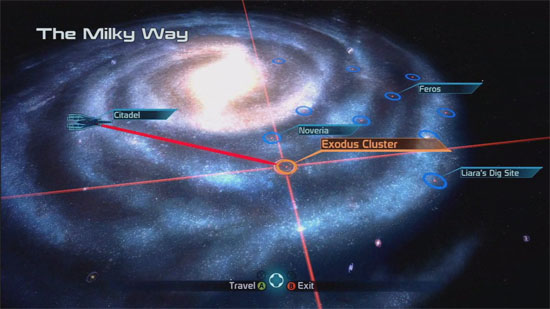
My recent… encounter with Mass Effect inspired me to sum up some thoughts I’ve been carrying around for some time now. As you might know, I spend some time digging into astronomy as a sort of a hobby. The reason (and the result) is that I’m very dissatisfied with the way space exploration is conveyed in Sci-Fi.

Milky Way in Mass Effect

It basically boils down to the same argument as my Space Battles post: most Sci-Fi/Space Opera conventions were established around the second world war. Remember that back then, nobody went to space yet. Hell, we didn’t even have rockets. Space exploration in Sci-Fi is therefore not informed by knowledge and experience but largely fictitious and forced to resemble seafaring. Fatally, the audience got used to that and writers didn’t bother to keep up with the development of astronomy. What we have today is the same bullcrap we had 60 years ago but with better graphics and more complicated words.

So I would like to point out what’s wrong with how spaceflight works in Sci-Fi and how we could fix that… and why we should! More after the jump…

Continue reading “Realistic Space Exploration”

About

The Game Design Scrapbook is a second blog of group of three game designers from Germany. On our first blog, Game Design Reviews we describe some games we played and point out various interesting details. Unfortunately, we found out that we also need some place to collect quick and dirty ideas that pop into our minds. Hence, welcome to Game Design Scrapbook. You will encounter wild, random rantings. Many of then incoherent. Some of them maybe even in German. If you don't like it, you might enjoy Game Design Reviews more.

Twitter

follow Krystian on Twitter
follow Yu-Chung on Twitter
follow Daniel on Twitter